Approve a packaging-only pilot for a baby bath spray water toy only after accepting the existing sample’s spray action, cleaning access and assortment role; keep the toy itself unchanged. For a nursery range spanning bath, teething, wooden and soft-play products, the pilot should answer one question: does the proposed pack present and retain each selected item as specified? Use a bounded sample quantity, a fixed artwork revision and written acceptance criteria—not a full-order commitment.
A packaging pilot can approve presentation, fit and assembly. It cannot establish age suitability, validate care claims or replace applicable product testing and certification.
Which play and care features must stay outside the packaging pilot?
Freeze the accepted product construction and play mechanism before comparing packaging, and review any requested product change separately.
For a spray bath toy, demonstrate how the sample takes in water, activates and releases water, then review the proposed emptying, cleaning and drying instructions. Record what is observed rather than assuming a squeeze, pump or powered mechanism. The packaging should show the accepted action accurately; a photograph of a water jet is not evidence of performance.
Teething products need their own mouth-contact and care review. Wooden toys need item-specific construction and finish information. Neither should inherit an age band or care instruction from a neighboring bath product simply because the range shares a graphic style.
For fishing, stacking and matching play, check that the pack identifies the included pieces and preserves their presentation. Review material feel on the physical sample: a catalog material field may describe only part of a mixed-component set.
As a purchasing boundary, allow changes to agreed artwork, outer-pack dimensions and packaging retention methods. Stop the packaging-only route if the proposal requires modifying the toy’s shape, material, finish, openings, attachments or mechanism.
Which catalog fields can anchor the pilot comparison?
| Cloth fishing game with stacking cups | Catalog description: cloth fishing, stacking cups and number-counting play. Recorded material: plush. Recorded packing: single item. Reference MOQ: 57. Confirm the component list, actual retail-pack construction and units per carton in the pilot quotation. |
|---|---|
| Six-piece math matching egg set | Catalog description: six math matching eggs. Recorded material: ABS. Recorded packing: packing card. Reference MOQ: 240. Recorded units per carton: 120. Confirm the sample, card construction and current packing arrangement. |
| Commercial interpretation | Treat both MOQs as historical reference values, not guaranteed pilot quantities. Agree the pilot quantity and packaging charges separately. The recorded carton quantity is not an order-multiple restriction. |
Which example should lead a bounded packaging trial?
Choose the matching egg set to evaluate a packing-card layout; choose the cloth fishing game to resolve component presentation and retention.
For a proposed common nursery-range graphic style, the matching egg set is the clearer card-layout starting point because its recorded packing is a packing card. Compare the proposed artwork with the accepted sample: are the set contents represented correctly, are approved instructions readable, and does the assembled pack retain the set in the intended orientation? Passing those checks supports that card revision—not the whole assortment.
The fishing game poses a different question. Its recorded “single item” packing does not define a finished retail format. Agree the included pieces and package construction before commissioning printed proofs, then check that packing does not obscure essential contents or distort the presentation.
Neither example should stand in for a spray bath toy, teether or wooden item. A shared artwork layout can be reused as a design starting point, but each selected item needs its own fit check, approved wording and signed sample reference.
Packaging-Only Pilot Approval Worksheet
| Product and revision identity | Record product name, internal item reference, accepted product-sample ID and date, artwork revision, packaging drawing revision and destination market. |
|---|---|
| Assortment role and age statement | Target: identify bath, teething, wooden or floor-play placement and the wording approved for this item. Observation: record the wording on the proof and its supporting review reference. Decision: accept wording or hold printed artwork. |
| Frozen product scope | Target: retain the accepted construction, materials, finish, component count and mechanism. Observation: compare the pilot sample with the signed reference and record any difference. Route product changes to separate review. |
| Permitted packaging changes | List exactly what may change: artwork, outer-pack format, dimensions, insert or retention arrangement. Identify any required review where packaging contacts or attaches to the toy. |
| Pilot quantity and spending boundary | Enter the agreed sample or pilot quantity, packaging-development charges, quotation reference and spending cap. State whether authorization covers mock-ups, printed proofs or a limited packed quantity. |
| Fit and presentation | Target: contents match the agreed list, the pack closes as designed, and the product remains in its intended display position during the agreed handling review. Observation: record results, photographs and any contact marks or displaced parts. |
| Artwork and everyday-care information | Target: product imagery, contents, age wording and care instructions match the approved references. Observation: record mismatches, obscured text and print-legibility findings on the assembled pack. |
| Commercial and destination review | Record the current quotation and agreed packing quantities. Identify the responsible reviewer and document references supporting the selected market and product. Keep packaging approval separate from order-release authorization. |
| Decision and conditions | Select PROCEED, HOLD or REJECT. State the exact packaging revision and quantity covered, reasons for the decision, and any conditions. PROCEED authorizes only the scope written here. |
| Responsible approval | Buyer name/signature: __________. Packaging reviewer name/signature: __________. Product or market reviewer, where needed: __________. Approval date: __________. |
| Follow-up closure | For each condition, record an owner, due date, correction evidence, recheck result and closure date. Name the person authorizing the next stage and identify the revision released. |
Who approves what, and when should the pilot proceed?
The buyer should authorize a defined packaging stage only after the product reference, packaging revision and acceptance conditions are agreed.
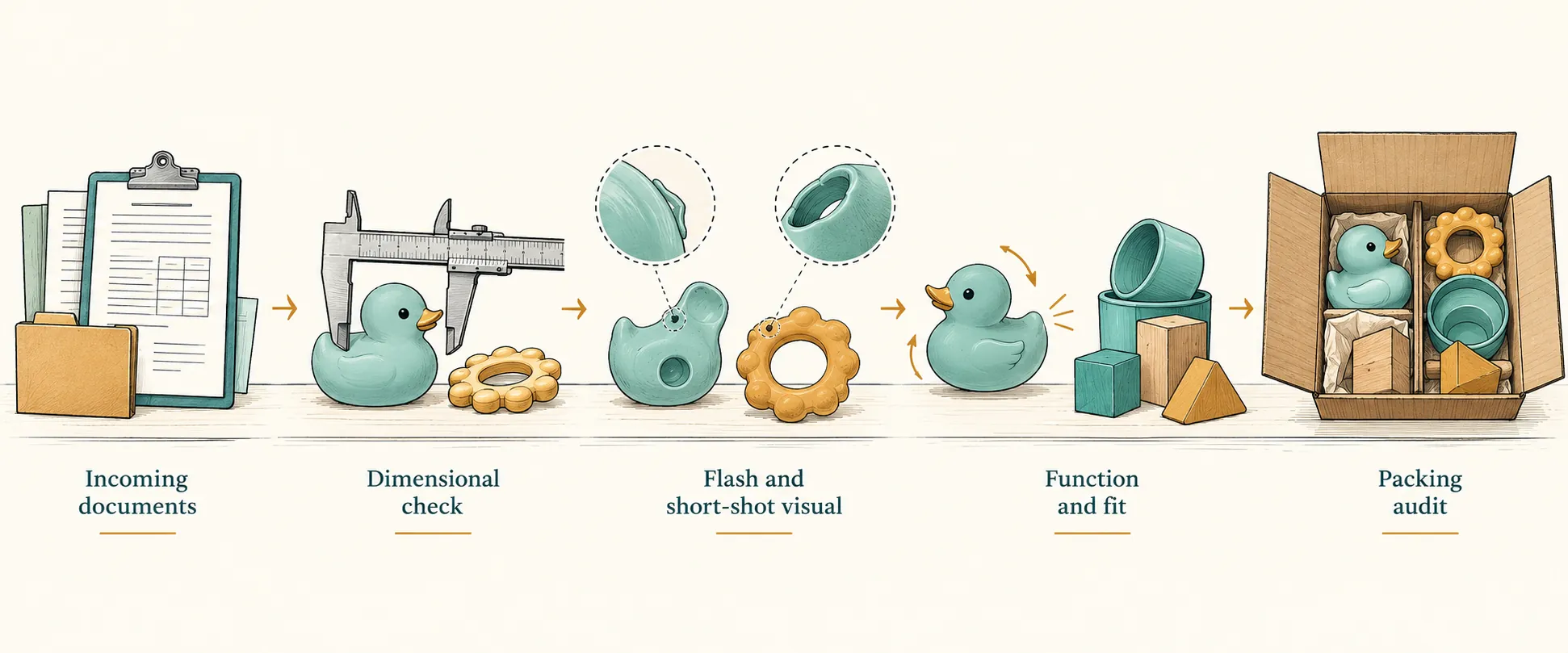
Use this sequence: sign off the frozen product and packaging specification; review the identified sample; inspect the assembled packaging; then record the limited-order decision. Assign packaging fit and artwork checks to a named reviewer, and route age, care and market-document questions to the person responsible for those decisions.
PROCEED when the selected revision meets the written packaging criteria and the authorized quantity and cost are accepted. HOLD printed packaging when product identity, contents or claim wording still needs resolution; an unprinted dimensional mock-up can remain a separate, limited exercise. REJECT the packaging-only route when the proposed solution requires changing the toy itself.
Keep the decision separate from regulatory approval. For example, CPSC identifies 16 C.F.R. part 1234 and its incorporated ASTM F2670 standard as requirements for infant bath tubs; that is not a bath-toy approval basis merely because a toy is used in water. CPSC Infant Bath Tubs Guidance
A packaging pilot does not satisfy any testing, certification or registration obligations applicable to the selected product. Its signed record supports traceability; it does not, by itself, prevent an undisclosed production change. Close conditions against the identified sample and revision before authorizing the next stage.