
Approve a baby bath spray water toy for packout only when its demonstrated spray action, care instructions and final pack match the agreed sample; apply separate checks to teething and wooden-toy lines. Confirm each product’s intended play role and age-stage evidence before accepting the assortment, then reconcile retail packaging, carton contents and current order terms. Record an approve, hold or reject decision per SKU—not one blanket approval for the whole assortment.
A spray toy belongs in the bath-play allocation, a teething ball in the mouthing-play allocation, and a wooden matching or manipulation toy in its specified play setting. Similar colors or coordinated packaging do not make their functions, care instructions or age positioning interchangeable.
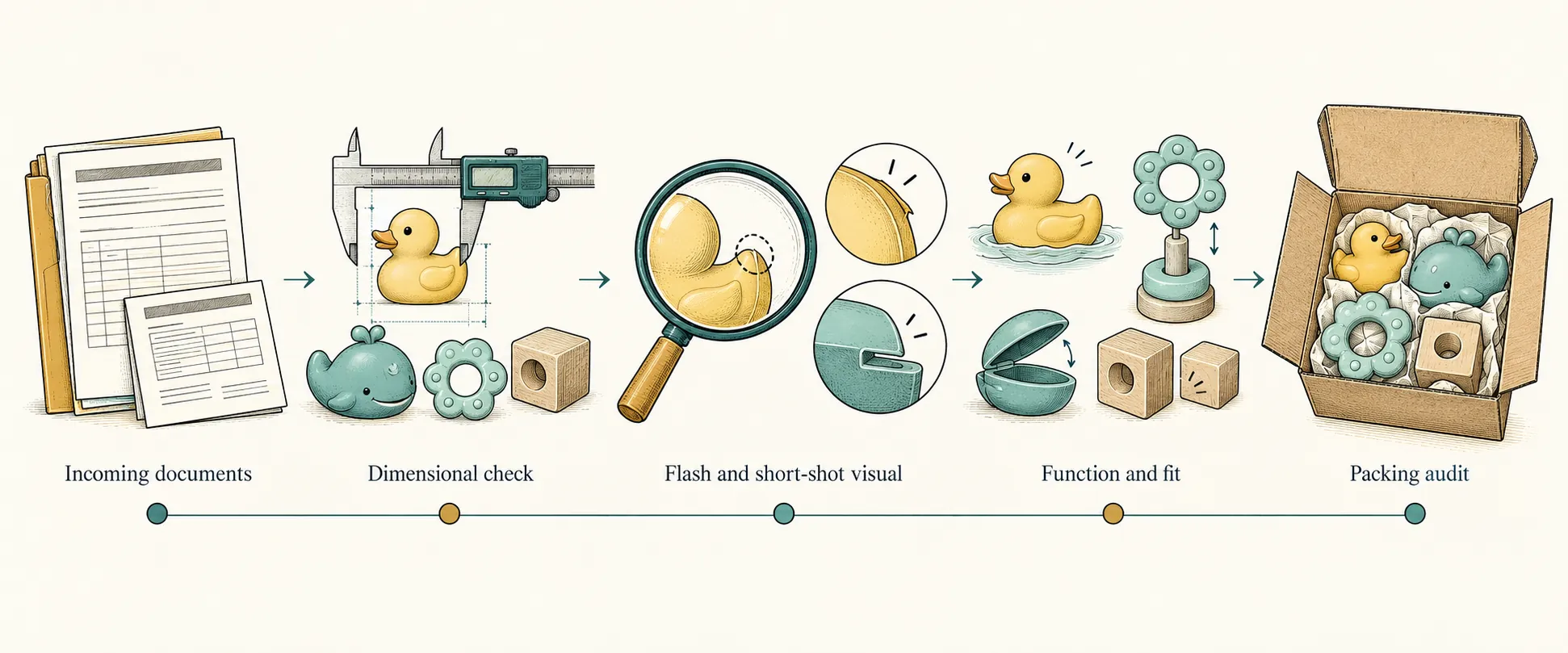
What should the sample demonstrate before packaging is approved?
| Bath spray toy: water action and after-use care | Identify how the spray is activated and demonstrate filling, activation and emptying according to the proposed instructions. Compare the action with the approved sample. Check access for the stated cleaning and drying method, and resolve any conflict between that method and the actual construction before accepting the pack instructions. |
|---|---|
| Teething toy: grip, surface and deformation | Compare the sample’s grip, surface condition, seams and response to handling with the agreed reference. Confirm which components the material specification covers. Do not approve boiling, sterilizing or dishwasher instructions merely because a catalog lists silicone. |
| Wooden toy: intended movement, finish and care | Demonstrate the intended matching, stacking or manipulation action for the selected model. Compare accessible edges, finish, joints and supplied pieces with the approved reference. Confirm the stated cleaning method rather than borrowing immersion instructions from the bath range. |
| Age stage and assortment placement | Record the proposed age band and play setting for each line. Have the designated safety reviewer assess the supporting age information, destination-specific documents and final labeling against the actual construction. A product name containing “baby” or “newborn” is not the approval basis. |
How do the matching-eggs and teething-ball packouts differ?
| 6 Math Matching Eggs | Recorded material: ABS. Retail packing: packing card. Reference MOQ: 240 units. Recorded carton quantity: 120 units. Confirm the matching action and complete set against the sample, then verify the card layout, product attachment and carton contents. |
|---|---|
| Sensory teething ball | Recorded material: silicone. Retail packing: color box. Reference MOQ: 100 units. Confirm the selected sample and box artwork, and obtain a confirmed units-per-carton count before approving the carton plan. |
What does this comparison mean for the assortment decision?
Approve these lines independently: an accepted card pack for the matching eggs does not establish acceptance of the teething ball’s color box or carton configuration.
Keep the material allocation honest. The matching eggs are recorded as ABS, so they should not fill a wooden-toy allocation. Likewise, the teething ball should not be assigned a bath-spray function without a separately agreed specification and demonstrated action.
If the matching-eggs sample and pack meet their agreed targets, that line can advance through its remaining release checks while the teething-ball line stays on hold until its carton count is confirmed. This is a decision rule, not a claim that either line has already passed inspection.
Reconfirm the minimum quantity for each line separately. An MOQ is not an order multiple, and a carton quantity alone does not require full-carton ordering. Record any agreed order-multiple or partial-carton restriction explicitly.
Which fields belong in the per-SKU packout worksheet?
| Record identity and revision | Worksheet ID/revision: ___; order and line reference: ___; product/model identifier: ___; supplier: ___; destination market: ___; inspection date: ___. Identify the sample revision and packaging artwork revision covered by this decision. |
|---|---|
| Product action and assortment role | Target: agreed mechanism, supplied components and play setting. Observed: demonstrated spray, matching, manipulation or other specified action; component count; any substitution or functional difference. Attach the relevant sample photos or demonstration reference. |
| Material, touch and care | Target: agreed component materials, surface/finish reference and care instructions. Observed: comparison with the approved sample and consistency of the final care text with the selected construction. Refer the claimed material specification to the supporting declaration or report; touch alone does not verify composition. |
| Age band and destination review | Target: intended age band, destination market and approved labeling. Observed: reviewer disposition, document references and correspondence to the selected construction. Record the responsible reviewer’s acceptance or outstanding action before release. |
| Retail pack and contents | Target: agreed card, color box or other specified pack; contents list; artwork revision. Observed: actual contents, orientation, attachments or inserts, readable labels and barcode identity where specified. Check the packed sample, not just the flat artwork. |
| Master carton | Target: units per retail pack, retail packs per carton, inner-pack arrangement where used, carton dimensions, gross weight and shipping marks. Observed: counted contents and measured packed carton. Keep retail-pack count distinct from the number of loose toy pieces. |
| Current commercial agreement | Target: accepted quotation revision, order quantity, current MOQ and any explicit order-multiple or partial-carton terms. Observed: agreement between the order line and supplier acknowledgment. Keep historical catalog references separate from accepted current terms. |
| Differences and disposition | Record each difference against its target, its effect on the proposed packout, the requested correction and the person authorized to accept it. Do not erase a difference by changing the target without a recorded revision approval. |
When should a buyer approve, hold or reject packout?
Approve only when the agreed release conditions are met; hold a line while a required confirmation or correctable mismatch remains open; reject the submitted configuration when an unacceptable difference will not be corrected or authorized.
For example, a teething-ball box that matches the agreed artwork can pass the retail-pack checkpoint while its carton plan remains on hold. Conversely, correct carton quantities do not resolve an unapproved change to the toy or its care instructions.
Packout confirmation records acceptance of a defined configuration. It is not a safety certification, and it does not replace the designated reviewer’s assessment of product and destination requirements.
What must the dated sign-off record contain?
| Decision and scope | Decision—approve, hold or reject: ___; order line/product identifier: ___; sample revision: ___; retail-pack revision: ___; carton configuration revision: ___. State whether the decision covers the entire line or only a named checkpoint. |
|---|---|
| Conditions and action ownership | Condition/action ID: ___; required correction or confirmation: ___; responsible owner: ___; due date: ___. For a hold, state exactly what must be accepted before release. |
| Approval responsibility | Buyer approver/name and role: ___; approval date: ___; packaging or quality reviewer/name and date: ___; age/destination reviewer reference and date: ___. Assign these responsibilities under the buyer’s approval procedure. |
| Closure and final release | Action ID: ___; correction evidence and revision: ___; closure reviewer: ___; closure date: ___; final release authorization and date: ___. Retain the earlier decision and link it to the closed revision. |