Photo approval does not lock in quality. The sealed golden sample on the QC shelf—not an email attachment—is the only reference that ends color, fit, flash, and function disputes before mass production. For age labeling and packaging, your sample gates must verify the physical piece plus its compliance paperwork, or you will pay for the drift on the second lot. This guide ranks the critical sample gates for OEM/ODM baby toy packaging, so you can decide which checks to enforce before committing to a supplier.
Key Takeaways
- Photo approval is insufficient: require a sealed golden sample that includes packaging and age-label artwork, stored on the QC shelf with a documented retention policy.
- Trade fair samples are hero units: refuse them as production standards; insist on a sample from the actual production tool, labeled with tool number and revision.
- Line clearance prevents cross-SKU contamination: enforce a signed clearance record for labels, colors, and work instructions before each new SKU starts.
- Tracking labels are mandatory, not decorative: ensure manufacturer, date, and lot appear on product or pack, and that the CPC matches the SKU, not the factory door.
- Compliance documentation is part of the sample gate: request the TDS and test reports for the toy and packaging before sealing the sample.
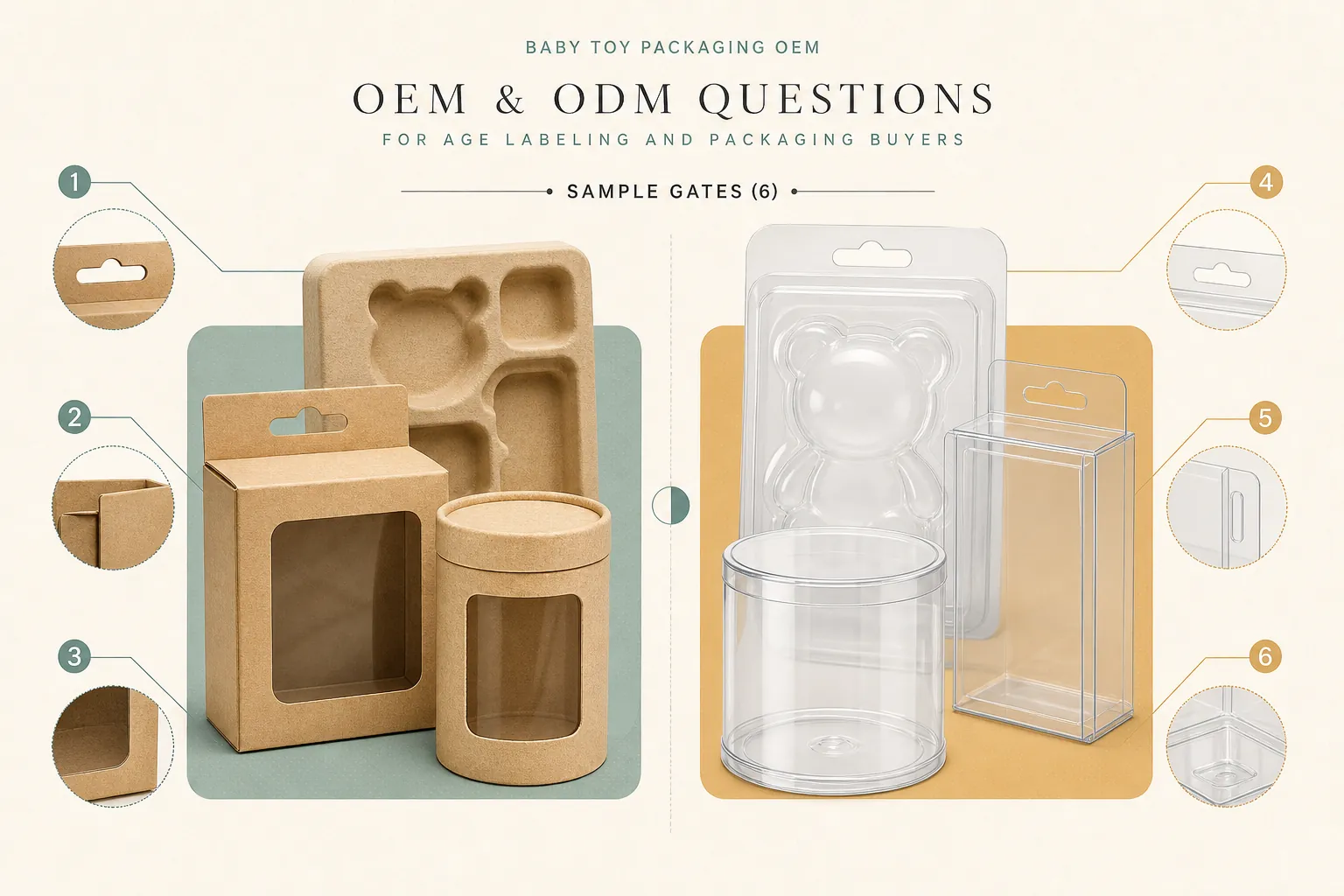
Sample Gate Comparison
| Gate 1: Golden Sample Approval | Require physical sealed sample with packaging and age-label artwork; verify color, fit, flash, function; confirm retention policy and revision card. |
|---|---|
| Gate 2: Line Clearance | Verify previous SKU materials removed; signed clearance record; check labels, colors, work instructions; audit checklist. |
| Gate 3: First Article Inspection | Compare first production unit to golden sample; check revision card match; validate tracking label content and CPC SKU match. |
Verifying the Golden Sample: What to Check Beyond the Photo
A sealed golden sample is only useful if it is the right reference. Before you approve it, confirm that the sample includes the packaging and age-label artwork, not just the toy body. Ask the factory to show you the QC shelf and the retention policy: how long is the golden sample kept, and is it stored away from light and handling? If the factory cannot produce a documented retention policy, treat that as a red flag and request a written commitment before mass production.
The golden sample must carry a revision card with tool number and revision. Without it, you cannot tell whether the sample matches the production tooling. At the sample approval stage, ask for a photo of the revision card alongside the sample, and later verify the same card on the first article of the production run. If the factory offers a trade fair sample as the standard, refuse: fair lighting misrepresents color and finish. Insist on a sample produced from the actual production tool, not a hero unit.
The golden sample is the baseline for color, fit, flash, and function. But you also need to verify the age-label and packaging compliance. Ask the factory for the TDS of the materials used in the toy and packaging, and check the Shore hardness and tear strength if the toy has soft parts. If the factory cannot provide a TDS with those values, request it in writing before the sample is sealed. Do not rely on a consumer blog list of packaging symbols; verify against your target market's regulations, such as ASTM F963 for the U.S. market.
From Sample to Mass Production: The Line Clearance and First Article Gates
The golden sample is the reference, but the line clearance is the gate that prevents cross-SKU contamination. Before the factory starts your new SKU, require a signed line clearance record confirming that labels, colors, and work instructions from the previous SKU have been removed from the hopper and the line. Ask the factory for their line clearance checklist and a copy of the signed record for your batch. If they cannot provide one, schedule an on-site or remote audit before production begins.
The first article of the production run must be compared against the golden sample, not against a photo. Check color, fit, flash, and function, and verify that the revision card on the first article matches the golden sample. Also confirm that the tracking label content is correct: manufacturer, date, and lot on the product or pack, and that the CPC is matched to the SKU, not the factory door. If the factory ships with a barcode but no tracking label content, reject the lot and require correction before shipment.
Define the acceptance criteria in writing: which tolerances are allowed for color and flash, and which defects are rejectable. If the factory cannot provide a TDS with Shore hardness and tear strength for soft parts, ask for it before the first article is approved. The buyer's next action is to request the TDS, the line clearance record, and the first article revision card, and to schedule a QC visit or remote audit before mass production.
Compliance and Certification: One Short Box
For U.S. market, toys must comply with ASTM F963 and CPSIA, including third-party testing for specific sections and a Children's Product Certificate (CPC). Age labeling affects testing scope: under-6 toys may require soluble heavy elements testing if mouthable, and under-3 toys must avoid small parts. Tracking labels are required on product and packaging. Confirm your supplier's test reports and CPC are SKU-specific before sealing the sample.
FAQ
What is the minimum order quantity (MOQ) for OEM baby toy packaging?
MOQ varies by supplier and product type. For OEM, MOQs often start around 2,500 units, but some suppliers offer lower MOQs for ODM or private label. Always confirm with the supplier, as MOQ affects your first-order economics.
How long does it take to get a golden sample approved?
Sample production and approval typically take 2-4 weeks, depending on tooling and material availability. Include this in your timeline, and ensure the sample includes packaging and age-label artwork before you approve it.
What certifications do I need for baby toys sold in the US?
For the US, toys must meet ASTM F963 and CPSIA requirements, including third-party testing for applicable sections and a Children's Product Certificate (CPC). Age labeling and tracking labels are also required. Confirm your supplier provides these documents.
How can I verify a supplier's line clearance process?
Ask for a signed line clearance record for your SKU, and request their checklist. If possible, schedule an on-site or remote audit before production to verify that previous SKU materials are removed.
What should I check in the first article of production?
Compare the first article to the golden sample for color, fit, flash, and function. Verify the revision card matches, and check that tracking labels (manufacturer, date, lot) are correct and the CPC is SKU-specific.
Sources
Request a Quote
Ready to source baby toy packaging with the right sample gates? Contact us to discuss your OEM/ODM project and get a tailored quote.