The deciding factor in sample-led baby-toy selection is the sealed golden sample on the QC shelf, matched to a lab report that covers your exact production lot—not the photo in the brochure. For importers, nursery distributors, specialty retailers, and ecommerce buyers, the smart move is to build a vendor qualification and assortment test program around physical evidence: the golden sample, a matching lab report, a small mixed-SKU trial, and sell-through data from a real test zone. This article walks through the buyer questions you need to ask, the red flags that should stop you from releasing bulk, and the most practical next action after you approve a sample.
Key Takeaways for Sample-Led Baby Toy Selection
- A golden sample report or type-test does not automatically cover a later production lot; you must match the report's SKU, materials, colors, and production date to your PO.
- Color matching can only be judged against the same resin grade, surface finish, lighting, and the approved master sample—so the physical golden sample, not an email photo, is the baseline.
- An absence of a CPSC recall record is not a safety certification; search the recall database by product, brand, and hazard as a due-diligence step, not as a substitute for compliance.
- Before you commit to bulk, run a small mixed-SKU sample order (e.g., 6 soft SKUs) with clear packaging, FOB quotation, and QC photos before shipment—then track sell-through velocity as a proxy for assortment fit.
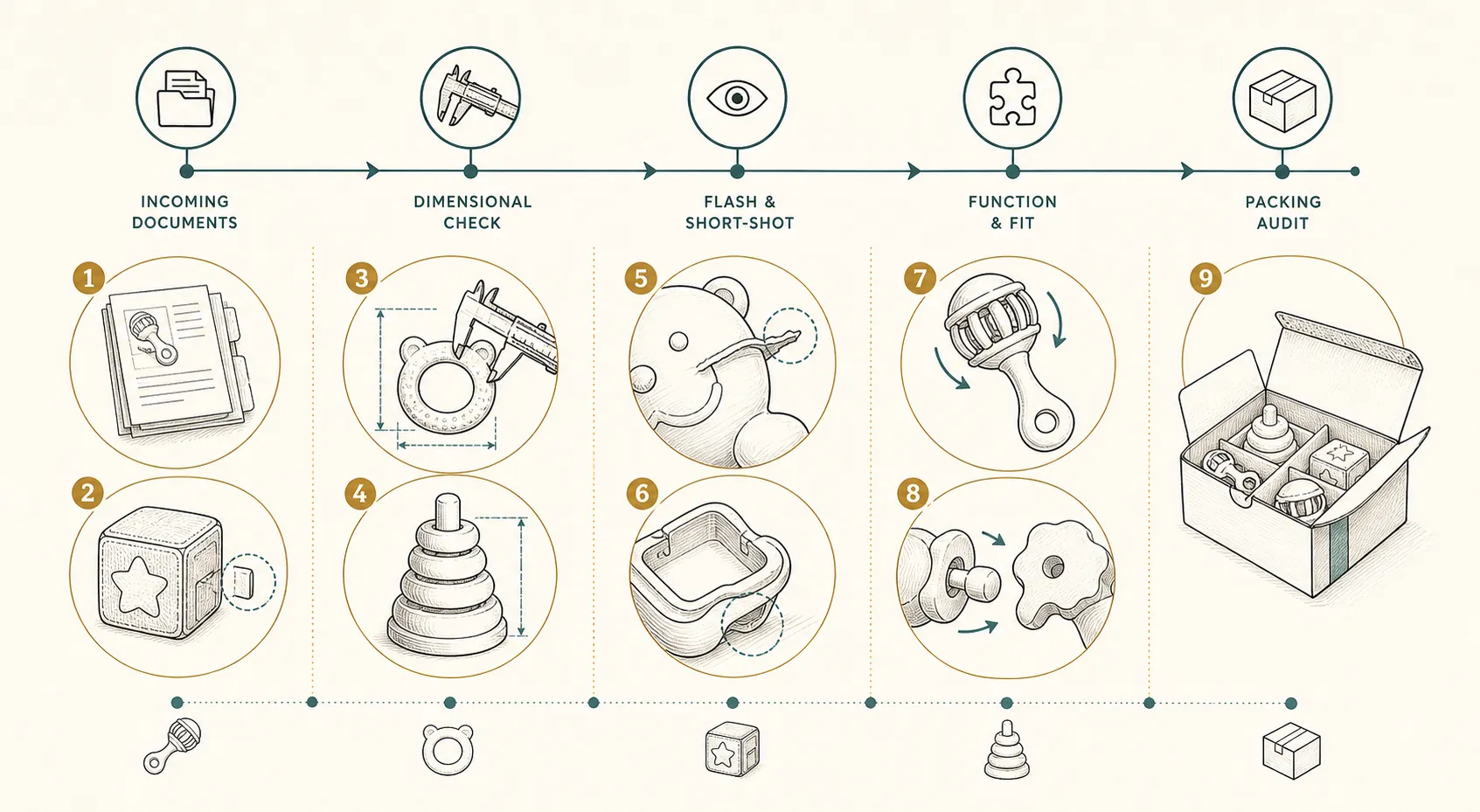
- The AQL number is not a catalogue sentence; it belongs in the agreed inspection plan on the PO. On the factory floor, failed lots are isolated, defect class recorded, and release happens only after rework.
Why buy baby toys in bulk? The margin and MOQ trade-offs
Bulk buying is where the margin math starts to work, but only if you can carry the risk of a wrong assortment. A sample-led approach lets you test the learning and development claim of a toy before you commit to a container. A small sample order costs more per unit and takes longer to reach sell-through data, but it protects you from the far bigger loss of a container full of toys that don't move.
MOQs vary by product and supplier. For example, a Montessori Lock Activity Learning Table (ABS plastic) has an MOQ of 80 units, while a Dinosaur Projector Drawing Toy (ABS with LED) has an MOQ of 120. These are typical figures, not rules—always confirm the MOQ in writing because it changes with packaging, color, and customization. Start with a sample order that spans several SKUs, not one deep cut.
How should a buyer compare suppliers on materials, packaging, MOQ, lead time, and documents?
Compare suppliers on the same five axes: materials, packaging, MOQ, lead time, and the documents they can actually produce. For materials, ask for the resin grade and surface finish—color matching fails if the supplier switches grade. For packaging, ask for the exact pack format (blister, box, polybag) and the language on the label; this changes your customs and retail compliance burden. For MOQ, get it in writing per SKU, and beware of a supplier who quotes a low MOQ but a high tooling cost for custom colors.
Lead time is the hidden margin killer. A supplier who promises 45 days but ships in 75 breaks your season. Ask for the lead time for a sample order and for bulk, and get a written commitment on the booking date. On documents, you need more than a COA: you need the lab report that matches the production lot, the inspection plan (with an agreed AQL number), and the packing list that shows the exact carton dimensions. A supplier who hesitates on any of these is not ready for your program.
What questions should a retailer ask before requesting a wholesale quote for baby toys?
Before you request a quote, you need to know your own program. The RFQ should state destination market, age grade, materials and colors, packaging language, requested tests, sample policy, tooling terms, and the requested trade term. If you skip any of it, you are asking the supplier to guess, and their quote will be a guess with a margin added.
Then ask the supplier: which retail chains do you currently supply, and can you provide references? Does this sample line operate under the same factory and export standards as your mass-market lines? Can you provide a sealed golden sample for each SKU before we commit to bulk? Where is your AQL number documented—PO, inspection plan, or both? How do you handle a failed lot—do you isolate, record defect class, and rework before release? The answers separate a factory that runs a professional QC floor from one that ships and hopes.
How to run a sample-led assortment test that generates real learning and development evidence
The goal of the test is to find the toy that sells and survives, not the prettiest one. Build a test zone into your store or display where customers can physically interact with the samples before you commit to volume. A 'test zone' works because it turns the sample into free marketing—customers squeeze, try, and decide. Track which SKUs sell out fastest; velocity is a proxy for assortment fit, and it is the evidence you need before you reorder.
For fragile or corner-sensitive items like LCD tablets or electronics, the shipping instruction is where claims are won or lost. Write double-wall, corner boards, ECT, and pallet height into the booking instruction. A 'thank-you note' as a booking instruction is a recipe for a container full of crushed toys and a denied claim. The booking file is part of your evidence trail—make it as detailed as your sample approval.
What makes a baby toys assortment clear and useful for importers, retailers, and distributors?
A clear assortment is one a buyer can evaluate against a defined set of criteria: age-appropriate play value, material safety, and packaging that communicates the developmental benefit. A useful assortment is one that sells—so the test zone data matters more than the brochure copy. When the sell-through velocity is strong, that is the signal to reorder before you run out.
Worked example: a sample-led assortment test (illustrative, not a real shipment)
Imagine you are an importer testing a learning and development line for a US retail assortment. You order 6 SKUs of soft toys (fruit, animals, stress balls) with clear blister packaging, FOB quotation, and QC photos before shipment. The MOQ per SKU is 120 units (varies by spec), giving a total of 720 pieces. You place the samples in two stores—one in California, one in Texas—and track sell-through for 30 days.
One SKU sells 80% of its stock, another sells 15%. The velocity data tells you to reorder the fast mover and drop the slow one before you commit to a container. But the QC photos reveal a color mismatch on the slow SKU: the bulk color is off from the golden sample. You isolate that lot, record the defect class, and request rework before release. Your booking instruction for the next order includes double-wall cartons and corner boards because the first shipment arrived with a crushed corner. This is the evidence loop that turns a sample test into a confident bulk decision.
What should you look for in the current compliance landscape?
The rules that apply to your sample are the same that apply to bulk, and they change over time. For the US, the CPSC recall database is a mandatory check—search by product, brand, and hazard, but an absence of a recall is not a certification. For the EU, the General Product Safety Regulation (GPSR) is a different regime from the Toy Safety Directive; they do not share the same deadline. As of the current date, the official text for many application dates is not confirmed—so the timeline is not confirmed from official text. Do not rely on a secondary article's title for a compliance date; check the official regulation text.
The practical rule is to ask your supplier for the lab report that matches your production lot—not just any report. A type-test or golden-sample report covers the sample, not the bulk. Match report SKU, materials, colors, and production date/cohort to your PO. Retain supplier records for materials, production, inspection, change control, and testing long enough to support your market and recall obligations.
Sample selection checklist: what to check and what raises a red flag
| Golden sample vs bulk | Check: physical piece on colour, fit, flash, function. Red flag: supplier wants to ship bulk on a photo approval. |
|---|---|
| Lab report match | Check: report SKU, materials, colors, production date/cohort match the PO. Red flag: report covers a different SKU or an old date. |
| AQL and inspection plan | Check: AQL number is in the PO or inspection plan, not a catalogue sentence. Red flag: supplier cannot document the plan. |
| Test zone sell-through | Check: velocity data per SKU from real customer interaction. Red flag: no data after the test window—extend or drop. |
| Packaging and shipping | Check: double-wall, corner boards, ECT, pallet height in the booking instruction. Red flag: vague 'standard export packing'. |
FAQ: Baby Toy Samples for Importers
What MOQ should I expect for a sample order of baby toys?
MOQs vary by product and supplier. For example, a Montessori learning table (ABS) has an MOQ of 80 units, while a dinosaur projector toy has an MOQ of 120. Always confirm per SKU in writing; a sample mix of 6 SKUs with 120 each is a common starting point, but the exact number depends on the supplier.
How can I verify that a lab report covers my production lot?
Match the report's SKU, materials, colors, and production date/cohort to your PO. A type-test or golden-sample report does not automatically cover a later production lot. Ask the supplier for a report that matches the exact batch you are buying.
What is the difference between the EU Toy Safety Directive and GPSR?
The Toy Safety Directive (2009/48/EC) sets safety requirements for toys, while the General Product Safety Regulation (GPSR) is a broader framework for non-food consumer products. They are separate regimes with different application dates. As of now, the official text does not confirm a single application date for all GPSR provisions, so check the official regulation before assuming a deadline.
How should I handle a failed lot in a sample order?
Isolate the lot, record the defect class, and require rework before release. The AQL number is defined in the agreed inspection plan on the PO, not in a catalogue. If the supplier cannot document the plan, hold the shipment.
What are the red flags when comparing baby toy suppliers?
Red flags include: a supplier who will not provide a sealed golden sample, a lab report that does not match the production lot, no clear AQL documentation, and vague packaging specifications. Also, an absence of a recall record is not a safety certification—check the CPSC database yourself.
Sources
Ready to Test Your Baby Toy Samples?
Use these buyer questions to structure your next vendor qualification round. If you are ready to compare suppliers on golden samples, lab reports, and inspection plans, send a detailed RFQ with your market, age band, quantity, pack format, and delivery terms. The right supplier will answer with evidence, not promises.