
Which bath-toy details should you photograph and test at the Hong Kong fair? Capture the emptying movement, the mounting contact, and the final drying position—not just the spray. A bubble maker with a shower head and a pull-line floating pig offer very different play, and your booth notes should reveal equally different after-bath routines.
At the , use this sequence to compare wholesale bath toys: tilt, fill, drain, stick, store. Build the visit around demonstrations that leave you with a reproducible care sequence and photographs tied to the actual sample.
What this shortlist covers
These catalogue candidates are preparation for January 11–14, 2027, not confirmed exhibits or tested drainage winners. Prices and carton minimums are dated references, with the actual demonstration configuration recorded separately.
Where should the bath-toy tour begin?
Begin with prospective Toys & Games Fair suppliers, then include Baby Toys & Activity at the concurrent Baby Products Fair. The places that category in the separate baby fair, making it a relevant extension of this bath-toy search rather than a reason to wander unrelated toy sectors.
Arrange your working tour by demonstration setup: water operation and drainage, mounted showers, then floating toys and storage. Put the model references and required setup in each meeting request so the comparison starts with an assembled sample, not a sealed box.
For arrival planning, places Exhibition Centre MTR station, Wan Chai MTR station, and Wan Chai ferry pier within a 10-minute walk. Use the to choose your approach, while keeping the demonstration agenda separate from the eventual booth route.
What should the bubble maker and electric bathtub demonstrate?
They should show both their play action and the complete emptying movement. combines automatic bubbles with a shower head; its catalogue unit-price range is USD 5.76–6.18, with a stated minimum of 5 cartons.
is a pretend-play electric shower bathtub, listed at USD 1.30–1.40 per unit with a 5-carton minimum. That is a useful fair comparison between different play propositions, rather than a cheaper-versus-dearer version of the same mechanism.
CPS198439's listed age bands are 2–4 and 5–7 years, so keep its pretend-play positioning in the meeting notes instead of treating the entire bath category as an infant assortment.
Before the demonstration, photograph the underside, accessible openings, and visible joins. Follow the normal filling and operating arrangement; for an electric format, the observation should not become an improvised immersion exercise.
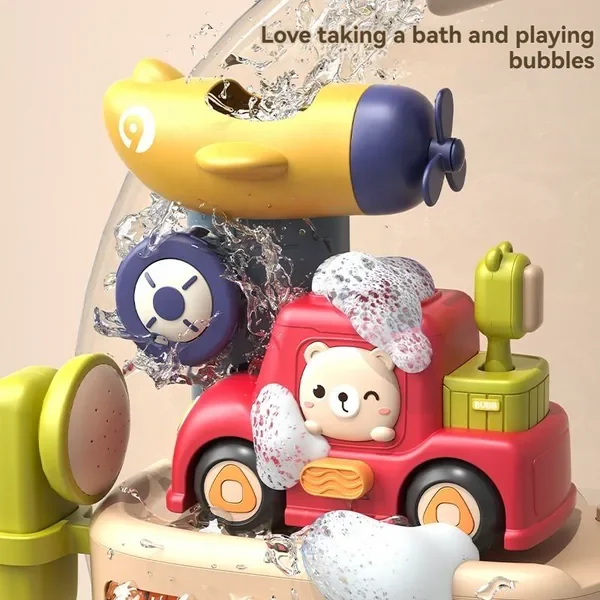
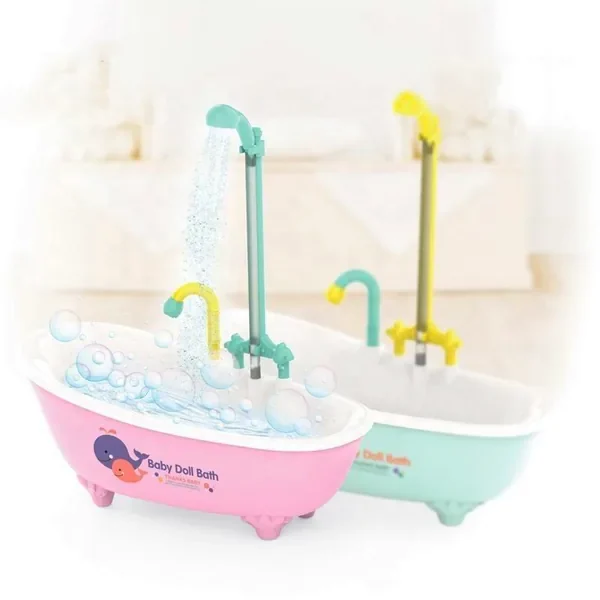
CPS300048's photograph has a truck-like lower body, an upper submarine form and a separate shower-head shape; identify the photographed assembly before following its water path. The CPS198439 image instead shows 2 colored doll-bath arrangements, with a standing shower and lower spout. Two photographed colors do not mean two bathtubs per sales unit. These different layouts suggest different close-ups: the connection between upper and lower bodies versus the basin corners and shower attachment.
Why give the dinosaur sprinkler its own demonstration?
Its sprinkler play makes the relationship between water output and emptying especially easy to document. is catalogued as a dinosaur water-sprinkler bath toy at USD 4.22–4.52 per unit, with a stated minimum of 3 cartons.
Take a wide photograph showing the spray relative to the toy and demonstration tray, followed by a close-up of the draining position. Note the actual turning or tilting used to release visible water, rather than writing “drains well.”
Keep the action and drainage images together in the fair record: the spray explains the shelf appeal, while the emptying movement shows what a caregiver would repeat after play.
How should the shower toys be compared for suction?
Compare the complete mounted assembly on a recorded surface wherever the displayed sample uses suction. supplies the rabbit electric-shower, double-sprinkler comparison, with a catalogue range of USD 4.94–5.29 per unit and a stated minimum of 2 cartons.
Its recorded 22 × 10 × 23.5 cm measurement describes the packing, not the assembled toy or its wet-storage footprint. Keep that distinction in your fair notes: a compact box does not tell you how much bathroom space the operating assembly occupies.
Use , catalogued as a shower-head and water-sprinkler toy, as the contrasting shower format. Photograph the rear assembly before attachment, showing the connection between the mount and toy.
For each suction-equipped sample, record the mounting surface, whether attachment starts wet or dry, the observed hold time and any downward movement. Photograph the rear assembly and release method. A second surface needs its own entry, rather than one universal suction rating.
What should the pig and submarine reveal about storage?
They should reveal a stable, reproducible drying arrangement after their water demonstration. is the pull-line floating pig, with a catalogue unit-price range of USD 0.79–0.85.
is the floating boat/submarine candidate, with water-spray wording in its title, a USD 0.92–1.00 unit-price range, and a stated minimum of 5 cartons. Compare the formats for their actual play and storage arrangements, rather than assuming the similar price points mean similar handling.
Place each sample in its intended drying position on the same clear shelf. Photograph from above for the footprint and from shelf level for the contact points; measure the assembled length, width, and height in cm in that position.
For the pig, include the pull-line exit and the line's resting position. For the submarine, include the underside and visible exits. Photograph a hook arrangement only when the sample actually provides one, and pair the final storage view with its written emptying, cleaning, and drying instructions.
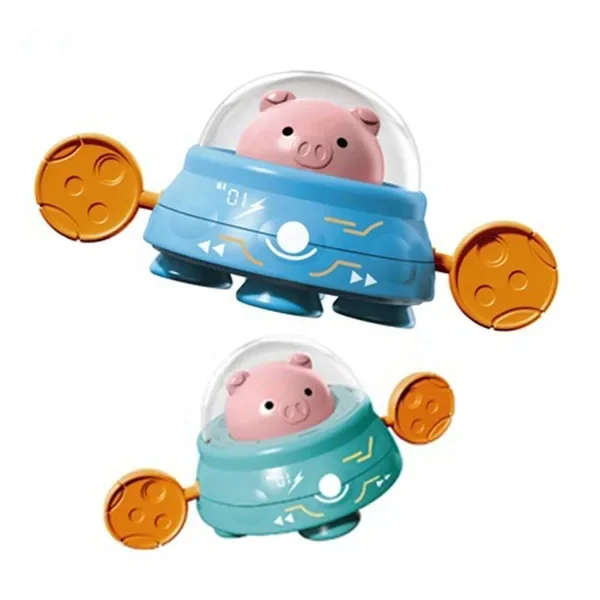
The CPS294887 photograph places a pig under a clear dome, with a round element on each side; the pull line is described in the title but not visible in this view. CPS302965 has a submarine-shaped body, raised bear figure, side porthole and rear propeller shape. Photograph the dome join and projecting side elements for the pig, then the rear projection and body base for the submarine: those are concrete differences a simple floating-toy label misses.
What changes with a pour-and-slide set?
It shifts the demonstration from a powered outlet to separately handled parts. CPS349366's original description lists a floating boat, suction starfish, water cup, slide and 3 fish. That gives a specific comparison: pour from the cup, follow the slide, then record where each component rests after emptying. The description names ABS+PVC, while the structured material field says ABS; neither allocates resin to each part.
CPS349366 records a product dimension of 16.5 × 8 × 8.5 cm and a package of 33 × 9.8 × 23 cm. The product field does not identify the full arrangement of all accessories; use the actual displayed layout for drying-space measurements. Its transport carton measures 104 × 44 × 99 cm, with a catalogue volume of 0.453 m³.
The transport record lists 48 supply units per carton and MOQ 144 units, described as 3 cartons. Gross weight is 32.2 kg and net weight 26.4 kg for that carton, not one boat. Its USD 2.93–3.06 reference range concerns the recorded configuration, rather than a quotation for each loose accessory.
CPS294952 offers a separate waterfall direction: its title identifies an animal-themed suction-cup DIY format. Its color box is 24 × 6 × 10 cm, with an explicit 5-carton minimum and USD 1.73–1.85 catalogue range. Those are packed-offer references; a wall arrangement needs its own mounting and emptying demonstration. Compare how separate parts are positioned and collected after play, rather than assuming that a small box guarantees little drying space.
The scorecard to carry between fair meetings
Use the same fields for each demonstrated sample. Write “not demonstrated” for an unobserved feature, and retain the conditions beside every measurement rather than assigning an unsupported universal pass time.
| Field | Record | Evidence to keep |
|---|---|---|
| Sample identity | Model, assembled configuration, exhibitor record, and photograph filenames. | An identifying view followed by the same sample throughout. |
| Drain time | Elapsed seconds or minutes, starting event, endpoint, orientation, and emptying movement. | A continuous view of the movement and visible water exit. |
| Seams and openings | Visible joins, accessible openings, and intended detachable parts involved in emptying. | Matching dry and post-drain close-ups. |
| Suction hold, where fitted | Cup count, surface finish, wet/dry condition, elapsed time, movement, and release method. | Rear assembly plus starting and finishing positions. |
| Wet-storage footprint | Assembled length × width × height in cm in the intended drying position. | Overhead and shelf-level views including relevant components. |
| Written care | Model-matched emptying, cleaning, drying, and storage instructions. | Care sheet or packaging instructions linked to the model. |
How do you turn the checklist into a fair meeting?
Send the demonstration agenda with the meeting request, then attach the resulting observations to the exhibitor record. The published period runs December 11, 2026–February 10, 2027; Click2Match runs January 4–21, 2027, providing planning windows around the physical visit.
begins at the fair's To Visit entry and covers personal details, company information, and matching preferences before successful-registration email confirmation. If registration is not ready, the site may display “Information will be coming soon.”
At the show, connects booth or product QR codes with details, favorites, meeting scheduling, chat, and enquiries. Pair that record with your photographs; a scan is a contact step, not an accepted appointment.
Your useful meeting conclusion is specific: observed drainage, observed mounting behavior, and a documented drying position. Those are shortlist evidence—not a “mold-safe” designation.
Send your bath-toy demonstration brief
Use Start an RFQ on RanToys to send your chosen model references, target market, and fair-planning brief. Include assembled samples, the normal water setup, supplied mounting accessories where applicable, and model-matched care sheets in the request, so the prospective business discussion starts with the details that will decide your shortlist.