Put age labeling, packaging data and FOB terms on the RFQ before you compare quotes. That is the fastest way to avoid hold-ups when sourcing bulk baby toys for a US or EU retail assortment. A useful toy RFQ states destination market, age grade, materials and colors, packaging language, requested tests, sample policy, tooling terms and the requested trade term. This turns a vague inquiry into a comparable purchase plan.
Key takeaways for bulk age-label and packaging sourcing
- Match the age label to the product's actual test evidence and to the destination market's rules. A certificate that covers one market or one lot does not automatically cover another.
- Ask for measured production packaging data, not just an artwork file. Package dimensions, quantity per inner and per carton must come from the actual box with the toy, inserts and labels inside.
- Set the quality baseline with a sealed golden sample on the QC shelf, not with a photo or a trade-fair booth sample. Label tool number and revision on the sample.
- FOB without a named place is a freight dispute waiting to happen. Write the Incoterms version and the actual port, such as Shantou or Shenzhen, in the RFQ.
- Do not accept a verbal AQL number. The inspection plan, defect classification and rework release procedure belong on the PO as an attachment.
How should a buyer compare baby toys suppliers on materials, packaging, MOQ, lead time and available documents?
Compare suppliers on five axes: material and age grade, packaging readiness, MOQ, lead time, and document coverage.
Materials and age grade: state the target age band in the RFQ. A 3+ label on a set with small parts is a red flag unless the product has passed the relevant small-parts test. Ask the supplier which tests the age grade is based on, and request the test report for that exact model.
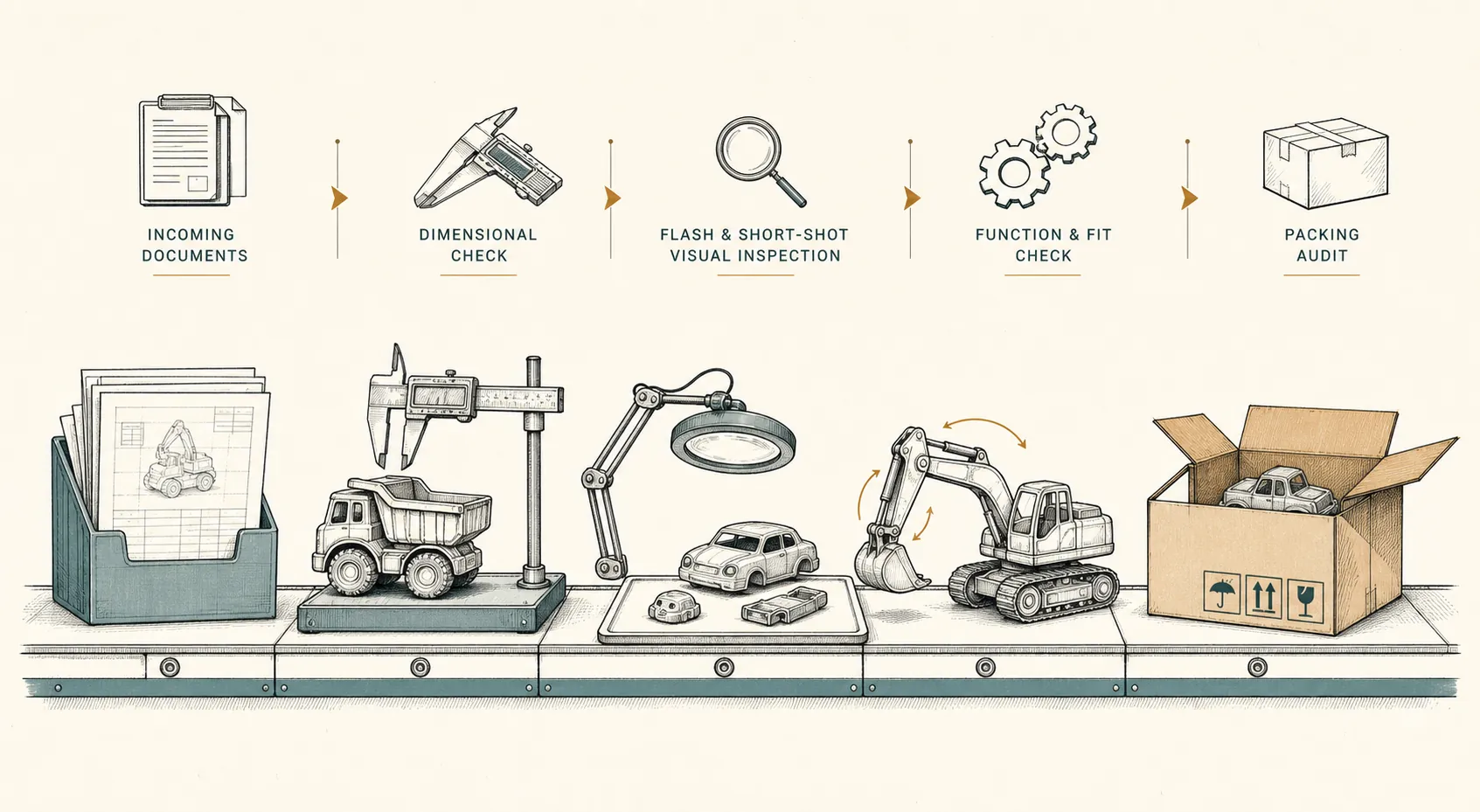
Packaging readiness: ask for measured production packaging data. Package dimensions and quantity per inner or carton should be based on measured production packaging, not only a preliminary artwork file. A carton sample should be validated with the actual toy, inserts, labels and accessories, because packaging failures often occur at interfaces between components.
MOQ and lead time: ask what the MOQ is per SKU, and whether it changes if you combine colors or add retail-ready packaging. A squishy set might have a higher MOQ than a toolbox set, but the MOQ is only meaningful if the lead time matches your season.
Documents: ask which certificate covers which test for this specific lot and SKU. UKCA plus a VOC file on an electric bubble machine are different papers. A buyer tried to use one certificate for both. The correct approach is to map market, lot, and which file covers which test. Paperwork that does not match the lot is not paperwork.
How to evaluate baby toy suppliers on packaging, MOQ and documents
| Material & age grade | Check: age band on the product and the test report that supports it. Red flag: age label that does not match small-parts risk. |
|---|---|
| Packaging data | Check: measured production packaging, carton sample with actual toy and inserts. Red flag: artwork-only dimensions that fail at the carton interface. |
| MOQ | Check: per-SKU MOQ and whether it includes custom packaging. Red flag: MOQ that changes after you commit to a season. |
| Lead time | Check: lead time per production stage, including tooling and sample approval. Red flag: a lead time that cannot fit your season. |
| Certification & labels | Check: certificate-to-lot mapping, CPC matched to SKU, tracking label content for US lots. Red flag: a generic certificate reused across products or markets. |
| Incoterms | Check: Incoterms version and named place (Shantou or Shenzhen). Red flag: FOB with no named place. |
What questions should a retailer ask before requesting a wholesale quote for baby toys?
Clarify which age band, which retail channel, which destination market, and how much packaging customization you require. The answers determine the MOQ, the documents, and the FOB price.
Ask the supplier five questions. First, what is the documented age label and packaging format for each SKU? Request product data sheets, not a verbal claim. Second, which certificate covers which test for this specific lot and SKU? Request the file name and lot number. Third, for US-bound lots, what is the tracking label content (manufacturer, date, lot) and how is the CPC matched to the SKU?
Fourth, what is the tooling fee, ownership, storage period, and what happens if the tool sits idle? A buyer once asked who owns the tool after paying a fee, but the contract had not frozen storage years or release conditions. Tooling policy is a document, not a handshake. Fifth, what is the inspection plan for this PO, including defect classification and rework release procedures? Request the plan document; do not accept a verbal AQL number.
What makes a baby toys assortment clear and useful for importers, retailers and distributors?
A clear assortment has three features: distinct age bands, packaging formats that match the channel, and carton data that supports the packing list. For example, a block of squishies and pop-its in assorted colors with retail-ready packaging and pieces-per-carton data makes the packing list straightforward. Without pieces-per-carton data, the warehouse cannot build a correct shipping manifest.
Age bands should be explicit, not implied. If you list a 12-month-old learning table next to a 3+ marble run, label both clearly so the buyer does not guess. For a US retail assortment, the age grade must be supported by the test evidence for that SKU. A clear assortment also separates the inner pack from the master carton. The inner pack is what the retailer displays; the master carton is what the freight forwarder counts. If the supplier cannot give you both numbers, you are not ready to quote.
Worked example (illustrative, not a real shipment)
Imagine an importer plans a 1,000-unit trial of a baby learning table for a US ecommerce launch. The table has a 12+ month age label, ABS plastic, and a 48-unit MOQ per SKU. The supplier quotes FOB Shantou, but the RFQ does not name the Incoterms version. The buyer assumes FOB includes loading at the port, and the supplier assumes it ends at the factory gate. That is a freight argument that lasts longer than production.
To prevent it, the buyer writes 'FOB Shantou, Incoterms 2020' in the PO and attaches the inspection plan. The inspection plan says the AQL is agreed on the PO, not in a catalogue sentence. At the warehouse, the buyer checks the carton. The carton is 60 x 40 x 40 cm, with 12 units per carton. The buyer opens one carton, finds the actual toy, inserts and labels fit, and the tracking label on the pack shows manufacturer, date and lot. The CPC is matched to this SKU, not to the factory door. That shipment clears.
Now change one detail: the supplier sends a similar table with a 3+ age label and no small-parts test report. The buyer does not catch it until the carton is opened at the US warehouse. That is a hold-up. The fix is in the RFQ: ask for the test report for the exact model and age grade before you place the PO.
What to check at the carton and pallet stage
Carton data is not just for the packing list. It affects freight cost, shelf display, and whether the goods survive the journey. Check three things at the carton stage.
First, measure the carton with the actual toy, inserts, labels and accessories inside. Packaging failures often occur at the interfaces between components — a label that curls, an insert that shifts, a toy that does not sit flush. Second, run a carton compression or stacking check. This helps verify that lower cartons will not crush and damage toy packaging during pallet and container storage. Third, compare the carton data to the packing list. If the supplier gives you pieces-per-carton on the artwork but the actual carton holds fewer units, the freight quote is wrong.
For electric toys, add an electrical-safety check. Electric toys may require insulation, dielectric, leakage-current or other electrical-safety checks depending on their power architecture. That is separate from the carton data, but it belongs in the same inspection plan.
How to prepare a comparable RFQ brief for bulk baby toys
A comparable RFQ brief has seven sections. First, product description: SKU name, material, color, and target age band. Second, destination market: US, EU, UK, or other, because the documents differ. Third, packaging spec: language, inner pack, master carton, and any retail-ready requirement. Fourth, quantity and MOQ: per SKU, per color, and whether you can combine.
Fifth, requested tests and documents: name the standard (for example, ASTM F963 for the US) and ask which file covers which test for this lot. Sixth, sample policy: golden sample, tooling terms, and what happens if the tool sits idle. Seventh, delivery terms: Incoterms version and named place, such as FOB Shantou (Incoterms 2020).
Send the same RFQ to at least three suppliers. If the quotes differ on carton data, age grade, or document coverage, do not chase the lowest FOB price. The price is only comparable when the packaging and documents are the same. A supplier who cannot give you measured carton data in the RFQ stage will not fix it at the container stage.
FAQ: Bulk age labeling and packaging sourcing
What MOQ should I expect for custom baby toy packaging?
MOQ varies by SKU and by packaging complexity. A simple retail-ready pack may have a lower MOQ than a custom insert or a multi-color set. Ask the supplier for the per-SKU MOQ and whether it includes custom packaging. Do not assume a single MOQ applies to every product in your assortment.
How do I verify that a supplier's certificate covers my US lot?
Ask for the certificate file name and the lot number it covers. A CPC must be matched to the specific SKU, not to the factory door. If the supplier cannot show you the file for your exact model and destination market, treat it as missing. UKCA and a VOC file on an electric toy are different papers; one does not cover the other.
Is FOB price the same as total landed cost for baby toys?
No. FOB price covers goods loaded on the vessel at a named port. It does not include ocean freight, insurance, duties, or port fees. It also does not certify the toy or replace CE, CPC, UKCA or other market evidence. Write the Incoterms version and named place in the PO, and add a separate line for the compliance documents.
What carton data should I ask for before quoting freight?
Ask for measured production packaging: carton dimensions, gross weight, units per inner and per master carton. The data must come from the actual box with the toy, inserts and labels inside, not from an artwork file. Also ask for a carton compression or stacking check to confirm the lower cartons will not crush during storage.
How do I set the quality standard for a bulk baby toy order?
Set the standard with a sealed golden sample on the QC shelf. Compare bulk to that physical piece for color, fit, flash and function. Do not accept a photo or a trade-fair booth sample as the production standard. Label tool number and revision on the sample, and define the inspection plan (including AQL) on the PO.
Sources
- Fair Packaging and Labeling Act: Regulations Under Section 4 of the Fair Packaging and Labeling Act Federal Trade Commis
- Packaging Systems Integration - Custom Labeling Systems & Solutions
- Packer Asia China's Leading Exporter and Manufacturer of Labeling, Packing and Filing Machines
- 实测豆包专业版:327张图3分钟归档,PPT配图“偶开天窗”,数据图表识别仍需“人工兜底”
Request a quote with the full RFQ checklist
You now have the sourcing map. The next step is to send a comparable RFQ to at least three suppliers. Use the seven-section brief above, and attach the inspection plan request. If a supplier cannot answer the packaging and document questions in writing, move on. The factory that gives you measured carton data and a lot-matched certificate is the one that will get your goods to the shelf without surprises.