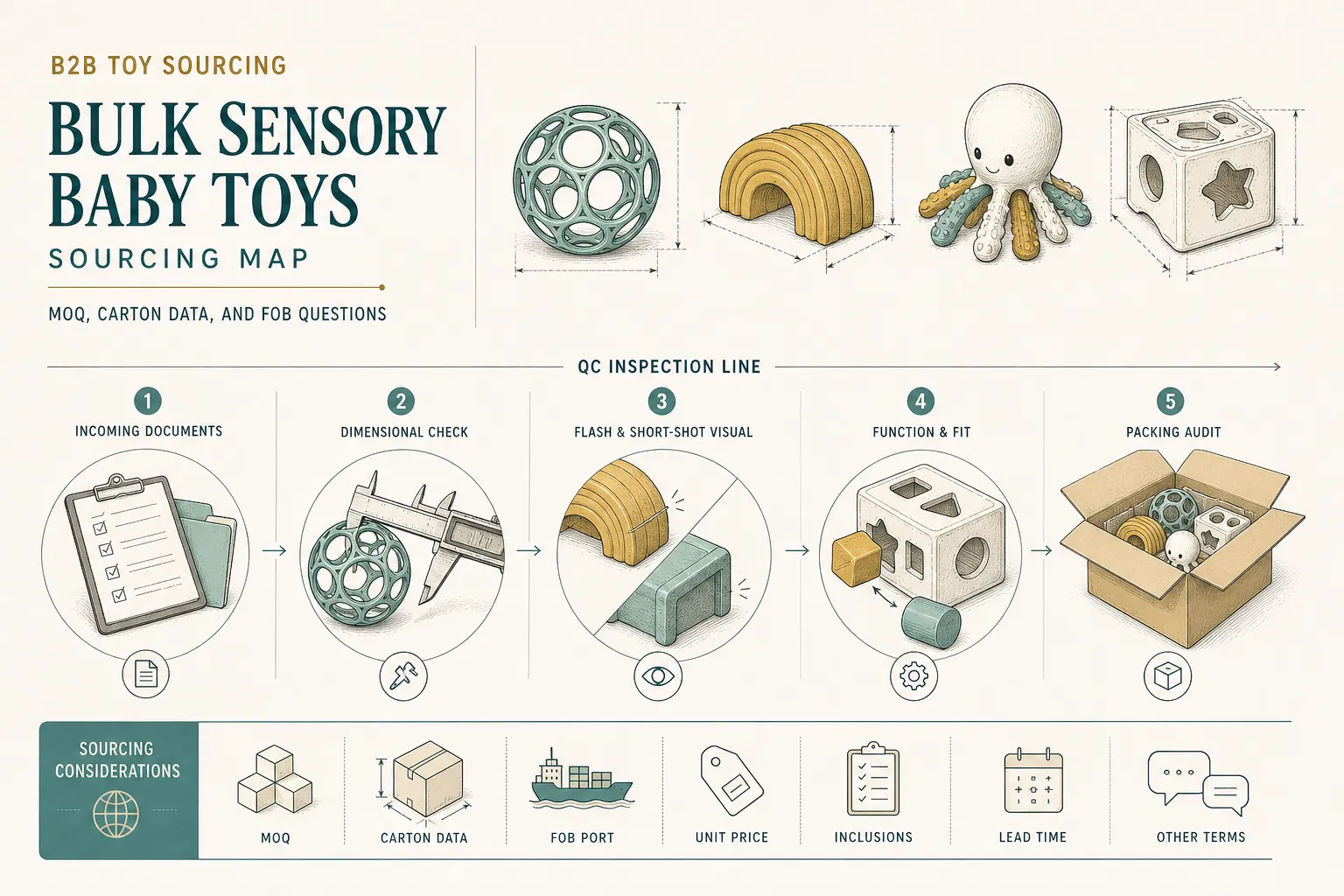
To source sensory baby toys in bulk, you must first decide whether you are buying a curated assortment or a single high-volume SKU, then build a comparable RFQ around MOQ, carton data, and FOB terms—not a generic price list. Start by mapping each product to your channel and age band, then request per-lot safety evidence and packaging specs before you commit to a container. The practical outcome is a quote-ready plan that lets you compare suppliers on the same fields and avoid the classic pitfalls of mixed loads and mismatch paperwork.
Key Takeaways
- MOQ varies by SKU and material—from as low as 36 units for a multi-functional plastic toy to 300 for a 10-in-1 busy cube—so ask for per-SKU MOQ and confirm whether it drops with a mixed-container order.
- Carton data (dimensions, gross weight, units per carton) is buyer-required but never standard; demand exact numbers per SKU and specify double-wall cartons, corner boards, and ECT rating for LCL to avoid crush damage.
- Safety evidence must be lot-matched: a Children's Product Certificate (CPC) and third-party test report for toys under 13 per CPSC, and for the EU, evidence per the new Toy Safety Regulation (EU) 2025/2509—not a generic file.
- Incoterms are not a vibe—write the version and named place (e.g., FOB Shantou or FOB Shenzhen) into the booking file to prevent freight disputes.
- Tooling ownership and idle-tool policy must be written into the contract—fee, storage period, and release conditions—or you risk losing your mold investment.
How to map product fit before you request a quote
Start with your channel. A specialty retailer needs a curated mix of tactile, auditory, and oral-motor items; a mass-market distributor might want a single hero SKU at a low FOB price. Use the product records to classify each item by sensory category and age band—but never assume developmental benefits. A silicone teething ball rattle (ABS+TPR) targets 6-12 months; a busy cube (ABS) suits toddlers; a felt quiet book appeals to the Montessori segment.
The age band is not just a marketing label—it drives safety requirements. CPSC defines a toy as any object for children under 14, but testing and certification apply to toys intended primarily for children 12 and under. So a teether for 6-12 months must meet small-parts and mechanical safety rules, while a wooden house set for ages 2-13 still needs a CPC for the 12-and-under portion.
Your RFQ should list each product ID with a fillable column for sensory category and age band. Do not pre-fill—let the supplier confirm, but you must be able to justify your own merchandising logic.
What carton data and packaging specs should you request?
Carton dimensions, gross weight, and units per carton are the backbone of your cost per unit and freight calculation. Ask for exact numbers per SKU—not typical ranges—because they determine how many fit on a pallet and how many cartons in a 20GP or 40HQ.
For LCL shipments, the booking instruction is where claims are won. Specify double-wall cartons, corner boards, an ECT rating that matches your stacking height, and a maximum pallet height. A carton compression check during inspection helps confirm lower cartons won't crush the toy packaging.
Incoterms must be written with the version and named place. 'FOB' without a place is a contract hole; write 'FOB Shantou' or 'FOB Shenzhen' as actually booked. Incoterms allocate trade responsibilities—they do not certify the toy or replace CE, CPC, or UKCA evidence.
Which safety documents and certifications apply to sensory baby toys?
For the US market, ASTM F963 is mandatory under CPSIA, codified at 16 C.F.R. part 1250. You must receive a Children's Product Certificate (CPC) and a third-party test report from a CPSC-accepted laboratory for toys intended primarily for children 12 and under. The standard covers small parts, sharp edges, cords, magnets, expanding materials, and sound-producing toys.
For the EU, Regulation (EU) 2025/2509 is the enacted toy-safety regulation: it entered into force on 2026-01-01 and applies mainly from 2030-08-01, with Articles 28-44 and 49-55 applying from 2026-01-01. Directive 2009/48/EC remains relevant during the transition. The Digital Product Passport and GPSR are separate frameworks—do not mix their deadlines.
Paperwork must match the lot. A UKCA certificate from one product does not cover a VOC file for another; ask for a mapping of which file covers which market and batch. For any foam or projectile item, verify the eye-area warning and that the foam tip matches the approved sample—'soft-looking' is not a standard.
If a toy has parts reasonably expected to contact real food (e.g., a pretend-food set), it is not automatically a food-contact article, but a separate food-contact and toy-safety assessment is required.
What MOQ should you expect for bulk sensory baby toys?
MOQ varies widely by product. In our catalog, you might see 36 units for a multi-functional musical toy, 90 for a bath toy set, 240 for a silicone teether, or 300 for a 10-in-1 busy cube. These are starting points—ask if the MOQ drops with a mixed-container order or if you can combine SKUs to reach a container minimum.
Do not assume the MOQ is fixed. Many suppliers reduce MOQ for repeat orders or for adding items to an existing container. But never accept a verbal MOQ; get it in writing on the RFQ, and confirm whether it is per SKU or per order.
For a mixed-container importer, a high-MOQ hero SKU can fill CBM alongside lower-MOQ filler. But generic unbranded filler may complicate your storytelling to retail buyers—so balance volume with brandability.
Sensory Baby Toys: Sample MOQ & Material Comparison
| Teether ball rattle (6-12 months) | Materials: ABS+TPR | MOQ: 240 | Price: $1.10 |
|---|---|
| Tissue box toy (6-12 months) | Materials: Cloth | MOQ: 216 | Price: $3.84 |
| Bath toy musical duck set | Materials: Plastic | MOQ: 90 | Price: $9.88 |
| Multi-functional piano bead maze | Materials: Plastic | MOQ: 36 | Price: $8.90 |
| Busy cube (toddler) | Materials: ABS | MOQ: 288 | Price: varies |
| 10-in-1 busy cube (travel) | Materials: ABS | MOQ: 300 | Price: $2.33 |
| Felt quiet book (customizable) | Materials: Felt | MOQ: 40 | Price: $3.80 |
| Color sorting counting set | Materials: ABS | MOQ: 120 | Price: $3.20 |
| Wooden house pretend play set | Materials: Wood | MOQ: 54 | Price: varies |
What should be in your RFQ template?
A comparable RFQ is the only way to compare suppliers fairly. Build a table with columns for Product ID, Sensory Category, Age Band, MOQ per SKU, Carton Dimensions (L×W×H), Gross Weight, Units per Carton, and FOB Price. Leave every cell blank for the supplier to complete—do not pre-fill, or you will anchor the response.
Add a packaging and shipping section with checkboxes: double-wall carton (yes/no), corner board spec, ECT rating, max pallet height (LCL), and Incoterms version + named place (e.g., FOB Shantou or FOB Shenzhen).
Include a safety evidence checklist: per-lot test report matching this production batch, UKCA/VOC mapping for the relevant market, eye-area warning for foam/projectile items, and confirmation that the foam tip matches the approved sample.
Tooling terms need their own block: tooling fee, ownership after payment, storage period included, and what happens if the tool sits idle for X months. Write it as a clause, not a handshake.
What questions should you ask a supplier before signing?
Ask these directly in your RFQ: What is the MOQ per SKU, and does it vary by product ID? Can you provide exact carton dimensions, gross weight, and units per carton for each SKU? Can you provide a per-lot test report matching this specific production batch, not a generic certificate? Which certificate covers UKCA vs. VOC for this lot, and can you map each file to the relevant market and batch?
For foam or projectile items: What eye-area warning is printed on packaging, and does the foam tip match the approved sample? For tooling: What is the tooling fee, who owns the tool after payment, how long is storage included, and what happens if the tool is idle?
Confirm the Incoterms version and named place on the booking file. Ask for the ECT rating, corner board spec, and maximum pallet height for LCL. And confirm the supplier is B2B only—no direct-to-consumer sales—to protect your distribution.
Worked example: a mixed-container order for sensory toys
Worked example (illustrative, not a real shipment): Imagine an importer in Lima wants to bring a 40HQ mixed container of sensory baby toys. They plan 2,000 units of a teether ball rattle (MOQ 240, so that passes), 500 units of a felt quiet book (MOQ 40, passes), and 300 units of a wooden house set (MOQ 54, passes).
The importer requests carton data and finds that the teether ships 100 per carton, the quiet book 50 per carton, and the house set 10 per carton. They calculate CBM and realize the teether's large cartons eat most of the container. To fix it, they swap the teether for a higher-density item or reduce the quantity.
During inspection, they find the quiet book's fabric has a loose thread that could be a choking hazard. The inspector flags it as a critical defect under AQL, and the lot is rejected unless the supplier reworks. The importer had specified double-wall cartons, so the packaging survived, but the product failed—so they ask for a per-lot test report on the next batch.
What should you check at delivery?
At delivery, verify the carton data matches the booking file—dimensions, weight, and units per carton. Check for crush damage, especially on corner-sensitive goods. If you specified corner boards, confirm they are present.
Confirm the Incoterms place and version match the freight bill. If the booking says FOB Shantou but the goods loaded in Shenzhen, you may face a freight claim.
For safety, spot-check labels and warnings. The eye-area warning on a foam launcher must be printed, not assumed. And the foam tip must match the approved sample—soft-looking is not a standard.
Retain the approved sample and use it as the reference for color, texture, logo, and assembly. A production release should use an identified sample, not a loose reference photo.
What should you watch for in 2026?
In the EU, Regulation (EU) 2025/2509 entered into force on 2026-01-01, but it applies mainly from 2030-08-01, with some articles applying from 2026-01-01. During the transition, Directive 2009/48/EC remains relevant. Do not assume the new rule's deadlines are already mandatory for your product—check the official text for the exact application dates.
For the US, CPSC continues to enforce ASTM F963 as a mandatory standard under CPSIA. If you are importing toys for children 12 and under, ensure the supplier provides a CPC and third-party test report. The standard text changes—review the latest version referenced in 16 C.F.R. § 1250.2.
The Digital Product Passport and GPSR are separate frameworks from the Toy Safety Regulation; do not mix their deadlines. Ask your supplier for a mapping of which document covers which market and lot.
FAQ
What MOQ should I expect for a bulk order of sensory baby toys?
MOQ varies by SKU and material. In our catalog, you might see 36 units for a multi-functional toy up to 300 for a 10-in-1 busy cube. Always confirm per-SKU MOQ in writing and ask if mixed-container orders lower the minimum.
How do I verify that a sensory toy complies with US safety standards?
Request a Children's Product Certificate (CPC) and a third-party test report from a CPSC-accepted laboratory for toys intended primarily for children 12 and under. ASTM F963 is the mandatory standard under CPSIA, codified at 16 C.F.R. part 1250.
What carton data do I need for a shipping quote?
Ask for exact carton dimensions (L×W×H), gross weight, and units per carton for each SKU. These determine your CBM and freight cost. Also specify double-wall cartons, corner boards, ECT rating, and max pallet height for LCL.
What does FOB Shantou or FOB Shenzhen mean for my order?
FOB is an Incoterm that allocates trade responsibilities; the named place determines where the seller's responsibility ends. Write the Incoterms version and named place into the booking file to avoid freight disputes. FOB does not certify the toy or replace CE, CPC, or UKCA.
How do I handle tooling ownership for a custom sensory toy?
Write a tooling clause that specifies the fee, who owns the tool after payment, how long storage is included, and what happens if the tool is idle for a certain period. Tooling policy is a document, not a handshake.
Sources
Request a Quote
Ready to build your RFQ? Use the checklist above to ask suppliers the right questions, and request a quote with per-SKU MOQ, carton data, and FOB terms. We're B2B only and can help you plan a mixed-container order from Shantou or Shenzhen.