
Choose bath toys for water play, pulling-string teethers for sensory handling, and wooden rattles for shake-and-listen play—but approve each shipping pack separately. For a baby bath spray water toy assortment, advance candidates to inquiry when their play role fits, then require agreed carton counts, outer dimensions, weights, strength specifications and shipping marks before packing approval. A recorded units-per-carton figure is a useful starting point, not a substitute for final packed measurements or evidence that the quoted bath toy actually sprays.
Keep two decisions distinct: whether a product deserves further consideration, and whether its shipping configuration is ready to approve. An incomplete carton specification need not stop an inquiry, but it should stop an unsupported freight-volume comparison.
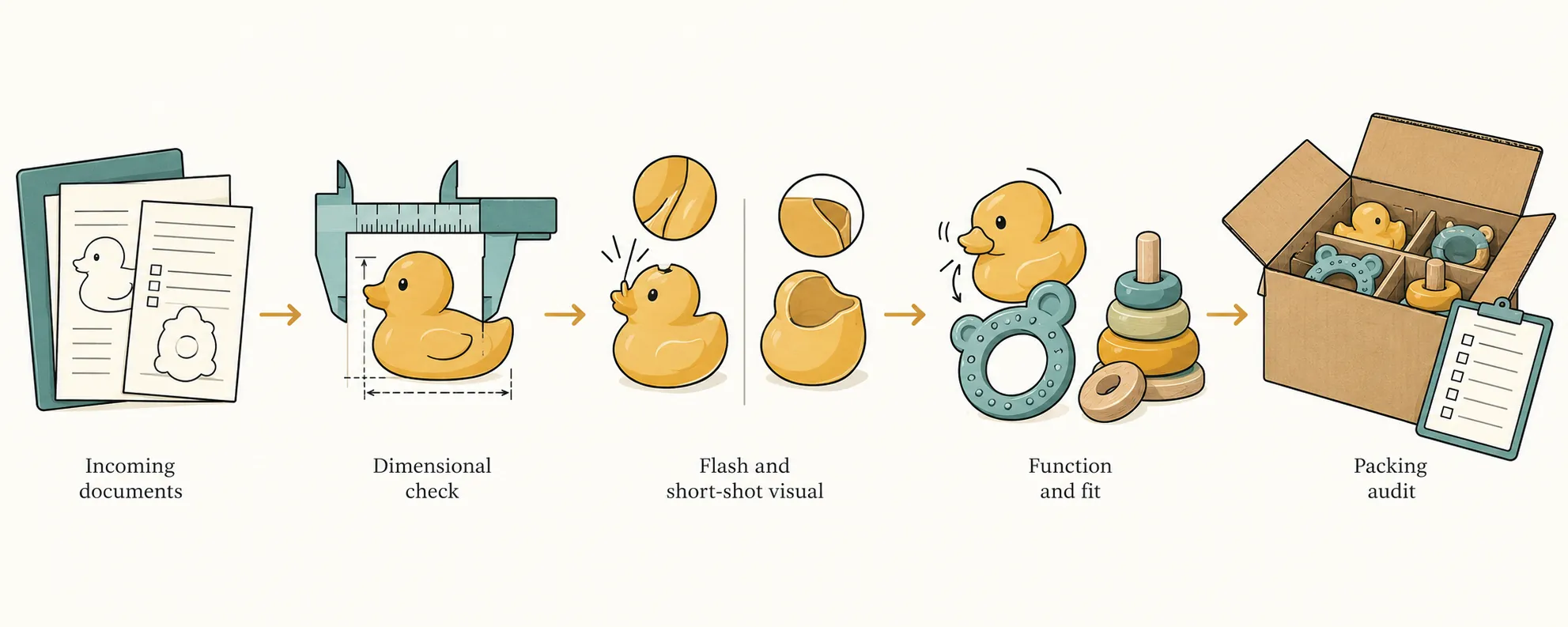
Which assortment lines should advance to packing review?
| Bath toy — water-play candidate | Record identity: CPS349366. Catalog description: baby bath toy; recorded material: ABS; retail packing: display box; reference MOQ: 144; recorded quantity: 48 units per carton. Advance to packing inquiry. Confirm the spray mechanism in the product specification, define whether the display box contains one or multiple sale units, and request outer-carton dimensions plus net and gross weights with units. |
|---|---|
| Pulling-string teether — sensory-play candidate | Record identity: CPS263800. Catalog description: silicone pulling-string sensory/teething toy; recorded material: silicone; retail packing: color box; reference MOQ: 64. Advance to product and packing inquiry, but hold carton-volume approval. Request sale units per inner pack, inner packs per shipping carton, total sale units per carton, outer dimensions and clearly defined weights. |
| Five-piece wooden rattle set — assortment contrast | Record identity: CPS308312. Catalog description: five-piece wooden rattle set with bells; retail packing: color box; reference MOQ: 42; recorded quantity: 42 units per carton. Advance to packing review only after confirming whether the carton count refers to complete five-piece sets. Request the component specification and a packing drawing showing how the boxed sets are arranged. |
Which packing data should be agreed before the PO?
Agree a revision-controlled packing proposal before the purchase order, then replace estimates with final as-packed measurements before shipment approval.
Identify the exact product, variant, retail pack, inner-pack arrangement and shipping-carton configuration. A count of 48 belongs to the bath toy’s recorded configuration; it cannot be transferred to a teether or to a redesigned bath-toy display.
Ask for external shipping-carton length × width × height in centimeters, gross and net weight in kilograms, sale units per carton, proposed carton count, carton construction and the shipping-mark artwork. Label preliminary figures as proposed. Product dimensions and retail-box dimensions are not shipping-carton dimensions, and an unqualified weight is not a usable gross-weight declaration.
Set any acceptable measurement tolerances in the packing agreement. A small difference within those limits can be accepted and recorded; a difference outside them requires evaluation, not an automatic declaration that the entire shipment has failed.
How should the closed shipping carton be inspected?
| 1. Identity and pack revision | Record to compare: approved packing specification and revision, product/variant reference and packing-list line. Inspect: carton identification and pack-configuration reference. Discrepancy signal: a different variant, obsolete revision or unapproved mixed configuration. Next decision: segregate the affected cartons and establish which approved configuration they contain before continuing reconciliation. |
|---|---|
| 2. External dimensions and units | Record to compare: approved outer-carton dimensions and buyer-agreed tolerances. Inspect: maximum external length, width and height of the sealed carton, including bulging, using the agreed orientation and centimeters. Discrepancy signal: measurements outside tolerance, inconsistent units or retail-box dimensions entered as carton dimensions. Next decision: remeasure, calculate the revised CBM and approve the change or require repacking. |
| 3. Carton count and declared contents | Record to compare: packing tally, carton-number schedule, packing list and agreed sale-unit definition. Inspect: physical closed-carton count, carton-number sequence, units marked per carton and any partial-carton designation. Discrepancy signal: duplicate numbers, missing cartons, unexplained mixed contents or a piece count presented as a set count. Next decision: recount and correct the tally or packing list; verify contents separately where necessary. |
| 4. Gross and net weights | Record to compare: approved weight definitions, packing record and final packing list. Inspect: measured sealed-carton gross weight in kilograms; reconcile declared net product weight against the supporting packing record. Discrepancy signal: gross and net fields reversed, unexplained weight variation or a weight without a defined basis. Next decision: reweigh, check the pack configuration and correct the declaration or investigate the contents. |
| 5. Carton strength, condition and closure | Record to compare: agreed board/construction specification, supplier packaging records, closure method and any specified packaging-test acceptance criteria. Inspect: visible crushing, tears, dampness, split seams, excessive bulging and closure conformity. Discrepancy signal: damaged cartons or construction and sealing that differ from the approved specification. Next decision: replace or repack affected cartons and obtain the agreed strength evidence; visual appearance alone does not verify board strength or transport performance. |
| 6. Shipping marks and final reconciliation | Record to compare: approved shipping-mark artwork, carton-number schedule and final packing list. Inspect: legibility, product/variant reference, quantity, carton sequence, dimensions and weights wherever those fields are specified. Discrepancy signal: marks disagree with the physical carton or final records. Next decision: correct labels or documents as appropriate, then reconcile the corrected version before approval. |
How do you calculate and reconcile carton CBM?
Calculate carton CBM from the final external dimensions in centimeters, then multiply by the number of cartons sharing that configuration.
Explicitly hypothetical example: a sealed carton measures 50 × 40 × 30 cm. Carton CBM = L(cm) × W(cm) × H(cm) / 1,000,000 = 50 × 40 × 30 / 1,000,000 = 0.060 m³. For 20 identical cartons, total volume = 0.060 × 20 = 1.200 m³. These are illustrative figures, not dimensions for any catalog item above.
If the same hypothetical carton actually measures 52 × 40 × 30 cm, its volume becomes 0.0624 m³ and the 20-carton total becomes 1.248 m³. Compare the dimensional change with the agreed tolerance, update the packing list and volume calculation, and decide whether to accept the revised pack or require correction. Do not retain the proposed CBM after accepting different packed dimensions.
Calculate each distinct carton configuration separately and add the totals. A partial carton may have different dimensions or weight; do not assign it the standard full-carton figures without checking.
What should the carton approval record contain?
Approve a carton configuration only when its observed packing data reconcile with the agreed specification, or when an authorized buyer has accepted a documented deviation.
Use one record per product and pack configuration. The preliminary assortment decisions above allow inquiry to continue; they are not shipment approvals. The final record should contain the following entries.
| Identity and revision | Enter the product reference, variant, retail-pack format, shipping-pack configuration, PO/line reference, approved specification revision, packing-list revision and inspected carton numbers. |
|---|---|
| Specified target versus observation | Record agreed dimensions, units per carton, carton count, gross/net weight definitions, construction, closure and shipping marks alongside the actual observations. Attach measurement photographs, scale readings and the supporting packing tally where relevant. |
| Decision and conditions | Select approve, approve with documented conditions, or hold the affected configuration. State the exact deviation and required action, such as replacing damaged cartons, correcting marks, confirming set-count terminology or revising CBM. |
| Responsible approver and date | Name the inspector and record the inspection date. Name the buyer or other authorized packing approver and record the approval date; identify who is authorized to accept any deviation. |
| Follow-up closure | Assign each corrective action to an owner and due date. Record the recheck result, corrected document revision, closure date and person authorizing closure before releasing any condition that blocks shipment. |
Which candidates should move forward now?
Move the bath toy and wooden rattle set into packing clarification using their recorded counts, and move the pulling-string teether into an inquiry that explicitly requests its complete carton configuration.
For the bath line, resolve the display-box unit definition and confirm the proposed spray feature. For the wooden set, settle whether the carton quantity means complete sets. For the teether, establish units per carton before attempting a meaningful volume comparison. None needs an invented carton dimension to remain under consideration.
Keep destination-specific product paperwork and product-safety testing on a separate release track. Carton approval establishes acceptance of the documented shipping pack; it does not certify toy safety or determine an appropriate age.