A parent stands at your counter on a Saturday with two first-birthday boxes in each hand. Box A is a 6-piece wooden set at $48; Box B is a 10-piece mixed set at $72. She asks one question: what will my 12-month-old actually do with each one? The answer should come from observable actions, not from a milestone chart on the lid. That is the buying rule for developmental toys for 1 year old gift ranges: stock the actions, label the age band, and skip the IQ promise.
The action map that survives contact with real 1-year-olds has four spines: stacking, posting, pulling and transferring. age-stage toy list gives the 7-to-12-month end as things to drop and take out (plastic bowls, large beads, balls, nesting toys), things to build with (large soft blocks and wooden cubes), and push and pull toys. The 1-year-old list adds board books, pretend toys, and cardboard and wood blocks that can be smaller at 2 to 4 inches, plus puzzles, large pegboards, and toys with dials, switches, knobs and lids. Build the range on those actions and the parent comparison becomes like-for-like.
What 12-month hands do: drop, take out, nest
At 12 months the dominant hand action is release, not construction. older-infant list names plastic bowls, large beads, balls and nesting toys as things to drop and take out, and large soft blocks and wooden cubes as things to build with. A first-birthday box that leads with a nesting bowl set, a 4-piece large soft block set and a 3-piece wooden cube set covers three release-and-rebuild actions in 3 SKUs. Add one push-and-pull item and the 12-month end of the range is 4 SKUs deep.
The material call at this end is size and softness. Large soft blocks absorb a 12-month fall onto a hardwood floor; wooden cubes at 1.5 to 2 inches give a heavier stack feel. The AAP's guidance says the best toys match a child's developmental skills and encourage new skills, and it names blocks, shapes, puzzles and trains as fine-motor favorites. That sentence is the merchandising license for a block-led 12-month box, with no outcome claim attached.
Care play belongs in the same box. The site profile positions RanToys around wooden baby toys, bath, Montessori, teething and soft plush, so a 12-month box can pair a wooden cube set with a teething ring and a machine-washable plush. The AAP check is concrete: parts on tight, seams and edges secure, machine washable, loose ribbons or strings removed, sturdy plastic, and a label that says nontoxic.
What 18 and 24 months add: smaller blocks, pretend, transferring
At 18 months the hand changes from release to placement. 1-year-old list allows cardboard and wood blocks that can be smaller than infant blocks at 2 to 4 inches, and adds puzzles, large pegboards, and toys with parts that do things such as dials, switches, knobs and lids. That is the posting and transferring end of the range: a 4-piece pegboard, a 3-shape sorter, and a 6-piece knob puzzle each give a 18-month hand a target smaller than the palm.
At 24 months pretend play enters the box. 1-year-old list includes toy phones, dolls and doll beds, baby carriages and strollers, dress-up scarves and purses, puppets, stuffed toys, plastic animals, and plastic and wood realistic vehicles. The AAP names symbolic/pretend play as a traditional category that helps children use words and stories to imitate and describe real life. A 24-month gift box that pairs a wooden vehicle with a doll and a board book covers pretend, language and fine motor in 3 SKUs.
The WHO 2019 guidance gives the activity frame: children 1-2 years of age should spend at least 180 minutes in a variety of physical activities at any intensity spread throughout the day, and quality sedentary time in interactive non-screen activities such as reading, storytelling, singing and puzzles is important. A gift range that includes a board book and a puzzle is aligned with that 180-minute active day and the non-screen sedentary slot, without a single developmental guarantee on the box.
The four-action spine: stacking, posting, pulling, transferring
Stacking is the first spine. A 6-piece wooden cube stack at 2-inch cubes gives a 12-month hand a release target and a 24-month hand a tower to rebuild. older-infant list names large soft blocks and wooden cubes; the 1-year-old list allows 2-to-4-inch blocks. One SKU covers both ends if the cube size sits at 2 inches.
Posting is the second spine. A 3-shape sorter and a 4-piece pegboard give a 18-month hand a hole to find. sort-the-shapes activity is described as helping children learn to classify objects based on colour, shape and size, which is the exact action a sorter trains. The AAP's fine-motor list names shapes and puzzles, so the sorter and pegboard sit inside the AAP's own category language.
Pulling is the third spine. older-infant list names push and pull toys, and the AAP's gross-motor list names push and pull toys and balls. A pull-along wooden animal at 12 months and a push wagon at 24 months give the range a floor-play item that also supports the WHO 180-minute active day for 1-2-year-olds.
Transferring is the fourth spine. A 6-piece wooden bowl-and-ball transfer set and a 4-piece nesting cup set give a 12-to-24-month hand a take-out and put-in action. shake shake shake activity is described as stimulating the ability to see, hear and grasp objects, which is the grasp-and-release action a transfer set trains. Four spines, four SKUs per box, and the parent can compare Box A and Box B action by action.
Four-action range map with age fit and compliance gate
The table below maps each action to the 12-, 18- and 24-month fit, an example toy type drawn from and AAP category language, and the US compliance check that applies to every piece in a 12-to-24-month gift box. The compliance column is the gate: a piece that fails the small-parts cylinder does not enter the range at any age band.
| Action | 12-month fit | 18-month fit | 24-month fit | US compliance check | Example toy type (/AAP) |
|---|---|---|---|---|---|
| Stacking | Large soft blocks, wooden cubes | 2-to-4-inch wood blocks | 6-to-12-piece block tower | Small-parts cylinder under 16 C.F.R. part 1501; choking-hazard label under 16 C.F.R. § 1500.19 if applicable; tracking label; phthalate CPC if plasticized | Wooden cubes and blocks |
| Posting | Large bead drop, nesting bowl | 3-shape sorter, 4-piece pegboard | 6-piece knob puzzle | Small-parts cylinder; choking-hazard label; tracking label; phthalate CPC on plastic parts | Shapes, puzzles, pegboards |
| Pulling | Pull-along wooden animal | Push wagon | Push-and-pull ride-on | Small-parts cylinder on wheels and axles; choking-hazard label; tracking label; phthalate CPC on plastic wheels | Push and pull toys |
| Transferring | Nesting cups, bowl-and-ball set | Sorting tray with 6 pieces | Transfer set with 8 pieces | Small-parts cylinder on every loose piece; choking-hazard label; tracking label; phthalate CPC on plasticized parts | Nesting toys, balls, containers |
| Pretend (24-month add) | Soft doll, board book | Toy phone, wooden vehicle | Doll bed, dress-up scarf | Small-parts cylinder; loose ribbon or string removal per AAP; tracking label; nontoxic label | Dolls, vehicles, pretend toys |
Compliance gates before the box ships
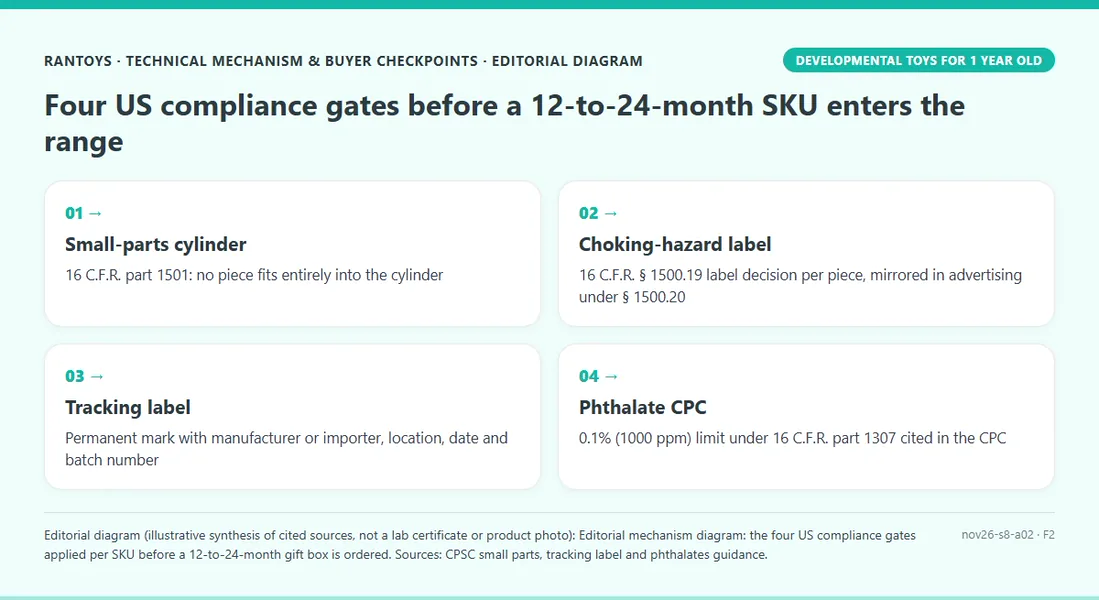
The first gate is the small-parts cylinder. CPSC bans children's products intended for children under 3 that present a choking, aspiration or ingestion hazard because of small parts under 16 C.F.R. part 1501, and a small part is any object that fits without compressing and in any orientation entirely into the small parts cylinder. Every posting piece, peg, bead and wheel in a 12-to-24-month box goes through that cylinder before the SKU enters the range. Rattles and pacifiers are excluded from the small parts ban at 16 C.F.R. § 1501.3, so a teething ring is not disqualified by the same test.
The second gate is the choking-hazard warning label. CPSC requires the label under 16 C.F.R. § 1500.19 for certain children's products that are or contain small parts, balloons, small balls or marbles, and any advertising for those toys must use the same warning under 16 C.F.R. § 1500.20. A gift box that mixes a large soft block with a 1-inch peg needs the label decision made per piece, not per carton.
The third gate is the tracking label. CPSC requires permanent, visible and legible marks on the product and its packaging showing manufacturer or importer name, location and date of production, and batch or run number. The tracking label is not a safety rule requiring CPC certification, so it sits on the physical piece and carton while the CPC carries the safety citations.
The fourth gate is phthalates. CPSC limits phthalates to 0.1% (1000 ppm) in accessible plasticized components of children's toys and child care articles under 16 C.F.R. part 1307, and the CPC citation is '16 C.F.R. part 1307 – Phthalates'. A teething ring or soft plastic wheel needs that CPC line; an unfinished wooden cube does not carry a plasticized component. Add the AAP material checks on top: parts on tight, seams and edges secure, machine washable plush, loose ribbons or strings removed, sturdy plastic, and a nontoxic label.
Illustrative planning example: two four-action boxes at RanToys terms
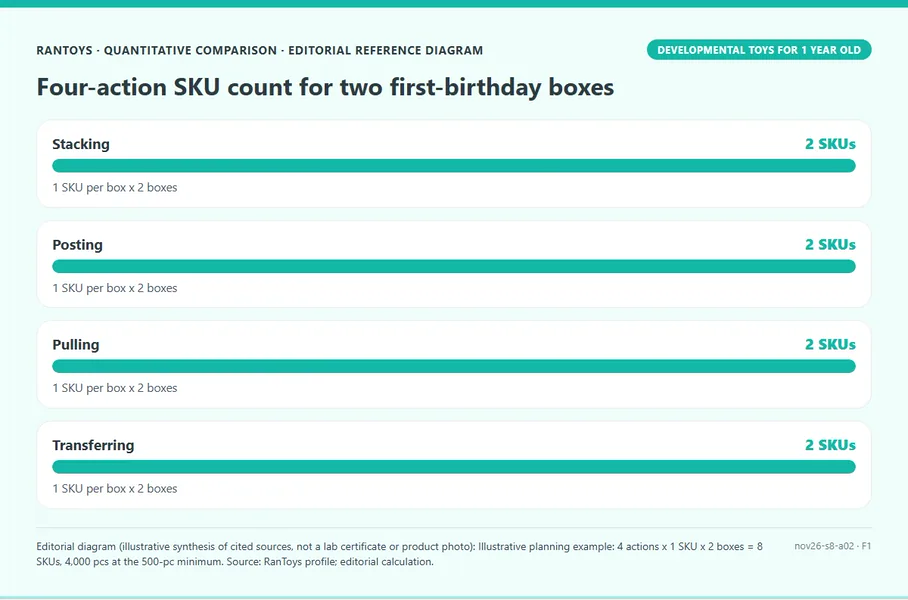
This is an illustrative planning example, not a price quote or a lab test. A boutique wants two first-birthday boxes, each covering the four actions (stacking, posting, pulling, transferring) with at least one SKU per action, ordered at RanToys' stated minimum of 500 pcs per SKU. The arithmetic: 4 actions x 1 SKU = 4 SKUs per box; 4 SKUs x 2 boxes = 8 SKUs; 8 SKUs x 500 pcs = 4,000 pcs total; lead-time window 25 to 35 days. The reader takeaway is that two four-action boxes need 8 SKUs and 4,000 pieces, so the action map is confirmed before cartons are committed, not after.
The same arithmetic shows why a single oversized assortment is the wrong order. A 12-SKU mixed carton at 500 pcs each is 6,000 pcs, 50% more than the two-box plan, and it spreads the buy across actions the parent cannot compare. The RanToys profile supports the plan with founding year 2012, MOQ 500 pcs, lead time 25-35 days, EN71 and ASTM certifications, and export to 80+ countries. Those are the only supply facts to quote; no test report, capacity or certification beyond that profile is asserted here.
What developmental toys should a 1-year-old gift box contain?
A 1-year-old gift box contains drop-and-take-out and nesting items for the 12-month end, then stacking, posting, pulling and transferring pieces as the child moves toward 24 months. older-infant list supplies plastic bowls, large beads, balls, nesting toys, large soft blocks, wooden cubes and push and pull toys; the 1-year-old list adds 2-to-4-inch blocks, puzzles, pegboards and pretend toys; the AAP names blocks, shapes, puzzles, trains, balls and push and pull toys as its fine-motor and gross-motor categories.
Do these toys guarantee developmental or IQ gains?
No. The AAP states the best toys match a child's developmental skills and abilities and encourage new skills, and frames play as exploration and mastery rather than an outcome guarantee. The range is sold on matching observable actions, and the AAP warns that most tablets, computer games and apps advertised as educational are not, and that digital toys should never replace face-to-face play.
What safety checks apply to a 12-to-24-month toy range?
Four US checks apply to every piece: the CPSC small-parts cylinder under 16 C.F.R. part 1501, the choking-hazard warning label under 16 C.F.R. § 1500.19, the permanent tracking label with manufacturer or importer name, location, date of production and batch number, and a CPC citing the 0.1% (1000 ppm) phthalate limit under 16 C.F.R. part 1307. Add the AAP material checks: parts on tight, seams and edges secure, machine washable plush, loose ribbons or strings removed, sturdy plastic, and a nontoxic label.
Build the two-box action range on the RanToys catalog
Take the four-action map to the RanToys catalog and build Box A and Box B side by side: 4 actions, 4 SKUs per box, 8 SKUs total, 4,000 pcs at the 500-pc minimum, and a 25-to-35-day lead-time window. RanToys supplies wooden baby toys, bath, Montessori, teething and soft plush under EN71 and ASTM, with export to 80+ countries. Confirm the small-parts cylinder result, the choking-hazard label decision, the tracking label fields and the phthalate CPC line per SKU before the carton is signed.
Sources
www.cpsc.gov — Small Parts Ban and Choking Hazard Labeling | CPSC.gov