
How should you split your show days between baby-category booths and the wider child-toy halls? Reserve mornings for a specific baby-play routine, then make a separate afternoon pass for sorting clocks, multifunction games and other child-toy comparisons. A silicone teether-rattle and a clock sorter deserve different conversations, even when both appear under early learning.
The and run January 11–14, 2027, at . The important routing detail is that Baby Toys & Activity belongs to the Baby Products Fair, while Educational Toys & Games is a toy-fair sector.
Use November–December to prepare routine labels, not guessed hall numbers. The route below is a buyer’s planning framework, and its catalogue products are demonstration references—not confirmed exhibits, an official floor plan or infant-age approvals.
Give each show day a different buying job
Keep the morning–afternoon boundary consistent, but change the decision you want to make. Add actual exhibitor locations to this sheet when available; the sequence is designed around buying tasks rather than unverified walking distances.
| Day | Baby-category morning | Separate afternoon pass | Decision to record |
|---|---|---|---|
| January 11 | Start with Baby Toys & Activity: teething and grasping, followed by floor stacking. | Use Educational Toys & Games for sorting-clock comparisons. | Which candidates belong to mouth-and-grip play, and which belong to placement tasks? |
| January 12 | Compare care-imitation controls and early pretend-play handling. | Give multifunction game formats their own demonstrations. | Does the product sell through a familiar routine or a menu of activities? |
| January 13 | Revisit close comparisons with a specific demonstration question. | Include Pop & Play if designer toys, IP or co-branding matter to your range. | Separate assortment candidates from wider inspiration. |
| January 14 | Close outstanding baby-range discussions. | Complete remaining child-toy comparisons and agreed meetings. | Record the preferred mechanism and the next business step. |
Grasp and mouth: begin with the handhold
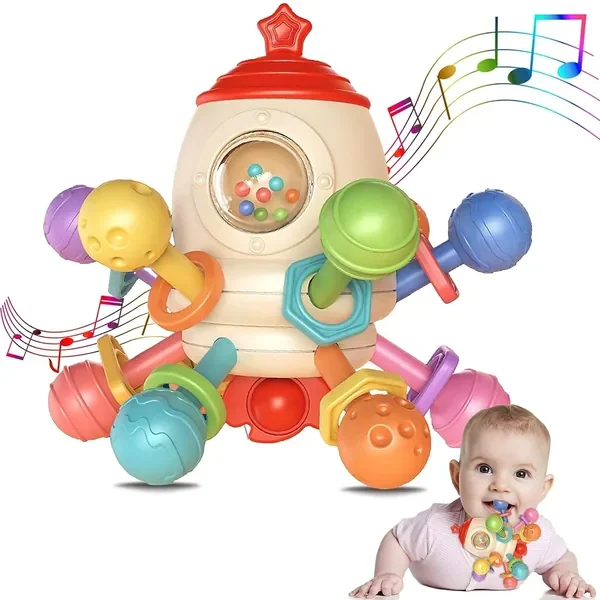
CPS280537 is a silicone teether-rattle whose catalogue age field reads “0–24m+.” At the fair, use this reference to focus the conversation on the relationship between grip, surface texture and the rattle response rather than a broad sensory label.
Its color box measures 18 × 15 × 18 cm, not the handhold itself. The gives a package reference; the October 9, 2026 catalogue snapshot records MOQ 240 and a USD 2.13 reference, while the product record carries a USD 2.13–2.62 range. Keep these dated catalogue values apart from a version-specific fair quotation.
Ask to see the principal grip, the transitions between surfaces and the movement associated with the rattle. That keeps your opening baby-fair conversation tied to a recognizable play action.
The selected photo makes the handling question tangible: a central body has a transparent bead window, projecting colored ends and rings around the connecting arms. A useful demonstration separates grasping an end, moving a ring and moving the whole body. The decorative musical notes do not establish a speaker, battery specification or tested sound output; they should not turn a rattle discussion into an electronic-toy promise.
Floor play: separate stacking from sorting
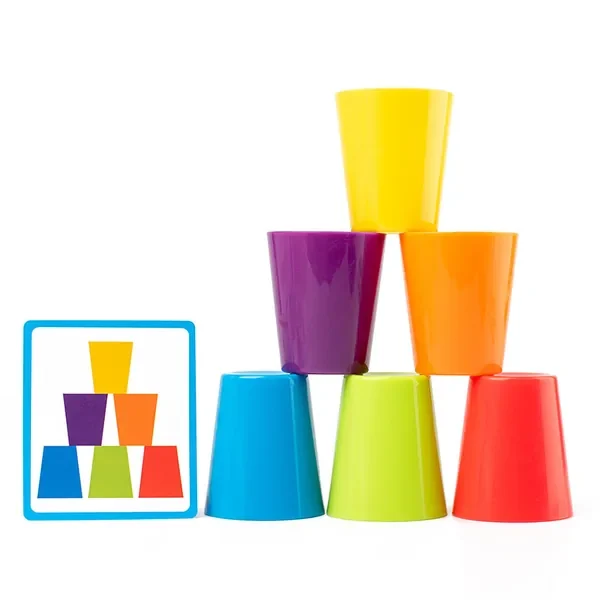
CPS307621 is titled a 2-in-1 stacking-cup and color-sorting toy. The photo shows 6 colored cups in a pyramid and a card with the same arrangement: reproducing an arrangement is a more specific demonstration than calling everything sensory play. Observe the base row, the contact between rims and the move from separate cups to a complete pattern.
The gives a color-box size of 20.5 cm × 11.5 cm × 5.5 cm, which describes the packed presentation rather than an assembled stack. Packing data shows 80 supply units per carton, a carton size of 59 × 47.5 × 43 cm and a gross weight of 21 kg—useful when you compare shelf-ready versus bulk carton plans.
Its age fields span 0–24 months, 2–4 years and 5–7 years, so that broad listing should not collapse your infant and older-child buying briefs into one. Keep the demonstration focused on the task you actually intend to merchandise.
The material field says Wooden, but the smooth, brightly colored cup photo does not resolve that identification. Keep material as an unresolved SKU field rather than placing this reference automatically on a wooden-toy shelf. Likewise, the card and the 6-cup arrangement identify this photograph, not an independently checked inventory for every offered version.
Care imitation: follow the flush button and activity controls
CPS344173 offers a striking contrast to the stacking cups: this ABS Educational Bathtub Toy uses toilet-style role play, with a flush button that triggers lights and sound. The supplier description also identifies levers, pull strings, knobs and ball tracks.
Its power configuration is 3 AAA disposable batteries, rather than a rechargeable system, and its packaging is a window box. The catalogue lists a package size of 32 × 17 × 21.5 cm, 24 pieces per carton and a reference MOQ of 120 units. Those details make the controls and electronic response central to the fair demonstration.
For your route, label this stop care imitation: follow the flush action, then the other controls, and decide which provides the clearest retail story. Keep the discussion on those documented mechanisms instead of treating the bathtub name as a floating-toy specification.
Early pretend: move the tea set away from the cup stack
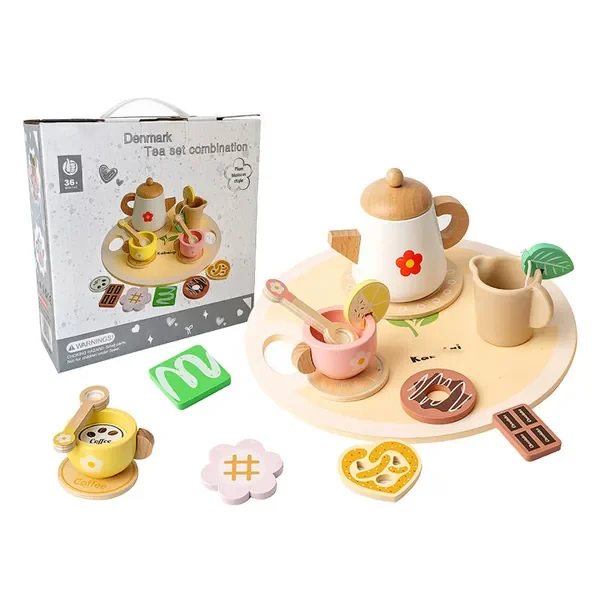
CPS309533 is described as a wooden tea-time pretend-play set in a 23 cm × 23 cm × 7 cm color box. Its useful fair demonstration is a serving-and-arranging sequence, not another stacking exercise.
The gives you a concrete reference for discussing how pieces are held and moved during pretend play. Packing is 20 sets per carton, with a carton size of 48 × 38 × 48 cm and a reference MOQ of 40 sets. Compare that proposition with the stacking cups before comparing finishes.
The RanToys category overview separates tactile, bath, wooden and other play categories; your fair notebook should go further by recording the action within each material group.
The tea-set photograph shows a tray, a pot with lid, cups with handles and pretend snacks. It explains the shift in buying purpose: a cup in this scene is held, placed and used to imitate serving, rather than stacked to match a pattern. Keep the photographed accessories with the photographed version; neither the title nor the scene establishes a food-contact use, coating specification or universal infant suitability.
Keep the clock and game table on the afternoon list
The ABS CPS312826–CPS312829 sorting-clock family carries a catalogue age label of 3+ and is described around shape, color, time and number play. Record the particular model discussed rather than merging the family into one generic clock entry. The record carries single-item packaging; its normalized MOQ of 144 and original wording of 3 cartons do not establish a carton quantity. Keep the family identification and clock mechanism as the comparison, rather than deriving a replenishment plan from those two fields.
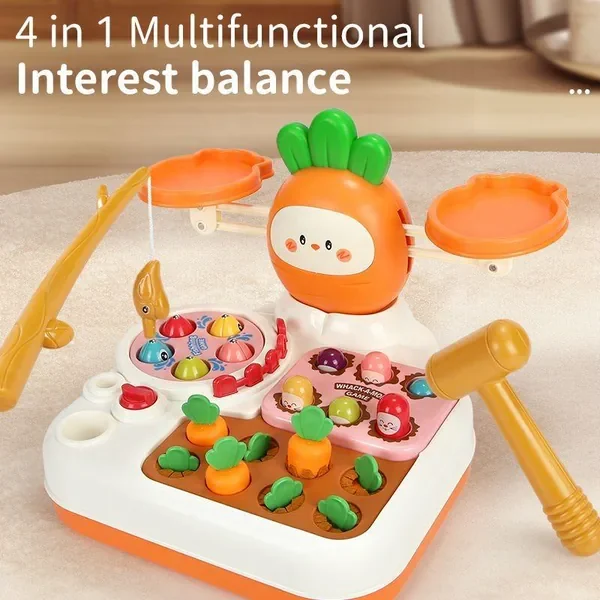
The contrasting CPS287878-CPS287877 listing is an ABS 4-in-1 electric balance-math game table, with fishing, gopher and carrot-pulling themes. Its measures 34 cm × 10 × 28 cm, not the dimensions of an assembled table. It is packed 12 pieces per carton, so the carton plan differs sharply from the clock family.
The game-table age fields span 0–24 months, 5–7 years and 8–13 years; that spread is a reason to keep its infant wording from steering your baby shortlist. Use the afternoon to compare concentrated sorting play with a broader activity menu, while keeping the morning’s grasp-and-care brief intact.
The selected game photograph shows fishing positions, a mallet activity, a carrot-pulling area and two balance pans. That visible division helps allocate demonstration time: follow each activity separately, then note how the central unit connects them. The picture belongs to a combined CPS287878-CPS287877 record; it does not identify the contents of each code separately or prove that the electronic function runs all activities.
Carry a question card for each routine
Grasp and mouth: Where is the main handhold? Which surfaces change texture? What movement produces the rattle response?
Floor play: How does stacking begin and finish? What distinguishes sorting from stacking? Which rims and contact surfaces are handled?
Care imitation: What does the main control activate? Which other controls work independently? If water use is part of the proposition, how does water enter and drain?
Early pretend: How are pieces gripped during serving? Which surfaces meet during play? What does the complete sequence look like?
Put optional inspiration before the final day
Pop & Play runs January 10–13, 2027, in the Convention Hall and welcomes trade and public visitors. Its designer-toy, IP and co-branding emphasis makes it a useful optional afternoon stop—not a replacement for Baby Toys & Activity.
The gives you the distinction needed to protect the baby-category route while still discovering ideas for a wider child assortment.
Turn the route into specific meeting requests
The published window is December 11, 2026–February 10, 2027, giving your reference sheet a use before and after the physical visit. Click2Match runs January 4–21, 2027, alongside that longer sourcing period.
At the fair, scans booth or product QR codes and provides product details, favorites, an e-floorplan, chat, enquiries and meeting scheduling.
A useful request reads: “I am comparing stacking and sorting formats for a stacking-and-sorting shelf; please demonstrate both sequences and propose a meeting time.” Attach the relevant reference, then record an appointment only when a time is agreed.
Keep the route sheet compact
- Use fields for routine, official sector, actual booth location, demonstration question and agreed follow-up; keep child-toy comparisons visibly separate from the baby brief.
- For arrival planning, places Exhibition Centre MTR station, Wan Chai MTR station and Wan Chai ferry pier within a 10-minute walk. Treat that as venue orientation rather than door-to-booth timing.
Next action: start with the official buyer-registration entry
Open the and use To Visit for buyer registration. process covers personal and company details, matching categories and purpose, applicable seminar choices, and email confirmation after successful registration; if the upcoming event displays “Information will be coming soon,” registration is not yet ready. Use the for the baby-category part of the route as well; concurrent dates alone do not establish shared admission or a single registration for both events.