
Advance baby bath, teething and wooden-toy candidates to purchase approval only after the sample, construction specification, draft packaging and destination-specific evidence have been reconciled. For US/EU buyers reviewing bath toys for baby baths around the Hong Kong Toys & Games Fair 2027, the next handoff should identify each item, its specification revision, open conditions, responsible approver and closure deadline. Keep commercial references separate from current quotations, and reserve final shipment records for the shipment stage.
The practical decision is not whether an item looks right for a nursery assortment. It is whether the documented construction supports the proposed age stage, everyday use and care instructions—and whether the buyer has approved that exact version.
Which fair dates should anchor the document review?
Use January 11–14, 2027 for physical-fair planning and January 4–21, 2027 for Click2Match planning, then recheck the organizer’s program before booking or setting meetings. HKTDC lists the physical fair at the Hong Kong Convention and Exhibition Centre. These are scheduled event windows, not promised sourcing or order-completion dates. HKTDC Fair at a Glance
A useful buyer planning choice is to request the initial document package before the online matching window and use meetings to resolve discrepancies. Supplier inquiries can begin while the scope is being defined; there is no reason to wait for a complete assortment brief before asking construction questions.
Do not treat an exhibit category as evidence of a particular supplier’s attendance, product availability or demand for baby assortments. Confirm meetings directly and keep the event calendar separate from the product-approval decision.
Which documents belong in the pre-PO handoff?
Request a controlled specification and sample record, a current quotation, an item-specific evidence package and draft packaging before purchase approval. The following are recommended purchasing controls for US/EU assortment review, not a universal statutory document list; the destination reviewer should identify the applicable requirements for each product.
Use the same item identifier and specification revision across the package. Where a laboratory report uses a different model reference, request a documented identity and construction mapping rather than rejecting or accepting it on the model name alone.
| Controlled specification and sample record | Owner: supplier product or technical contact; buyer quality reviewer accepts the baseline. Useful fields: supplier model, buyer item cross-reference, revision/date, sample identifier and photographs, component list, materials by component, dimensions, piece count, intended use, proposed age band and care method. Mismatch consequence: the buyer cannot establish whether the sample, proposed production item and supporting evidence describe the same construction. |
|---|---|
| Current quotation and commercial terms | Owner: supplier sales contact; buyer purchasing owner reviews. Useful fields: exact item and revision, order quantity, current MOQ, unit price and currency, included packaging, quotation validity, delivery terms, payment terms and proposed schedule. Mismatch consequence: the comparison may exclude packaging costs, use an outdated minimum or price a different version. Reconcile the quotation before committing the PO. |
| Item-specific evidence package | Owner: supplier technical contact assembles records; buyer product-safety or destination-market reviewer evaluates them. Useful fields: complete reports and applicable supporting documents, tested model and photographs, construction and material coverage, tested age scope, standard editions and test dates, results, variant mapping and change history. Mismatch consequence: evidence for a different construction or scope cannot substantiate the proposed item without further review. |
| Draft packaging and care artwork | Owner: supplier packaging contact prepares; buyer artwork and destination-market reviewers approve. Useful fields: artwork revision, product identity, proposed age statement, instructions, care and drying directions, warnings, destination-specific text and responsible-party details as applicable. Mismatch consequence: the pack may describe an unapproved age, care method, material or configuration. Correct the draft before authorizing print. |
How do the teething-ball and rainbow-stacker records compare?
The teething-ball record supports a silicone material reference, while the rainbow-stacker record supports a color-box format and a recorded carton quantity; neither record alone approves an age claim, intended use or destination-market suitability.
The comparison below uses catalog references dated October 9, 2026. Treat prices and MOQs as dated commercial references, not current offers. The teething ball is a teething candidate, not a verified bath-use substitute; the stacker’s product name is not a component-level material specification.
| Product identity | Sensory teething ball — catalog identifier CPS280536. Montessori rainbow stacking toy — catalog identifier CPS280260. Retain these identifiers in the document cross-reference, then match each to the supplier’s model, sample and specification revision. |
|---|---|
| Material reconciliation | Teething ball: silicone is the recorded material. Confirm which components that description covers. Rainbow stacker: request a component-level material and finish specification before accepting the wooden-toy description as the purchasing specification. |
| Retail packaging | Both records specify a color box. Obtain the actual draft artwork, included-piece layout and care text for each item; a shared pack-format description does not establish identical contents or instructions. |
| Reference MOQ | Teething ball: 100 units. Rainbow stacker: 60 units. Reconfirm both in the current quotation for the selected construction and packaging. |
| Carton quantity | Rainbow stacker: 60 units per carton are recorded. Request the proposed carton quantity for the teething ball. Keep carton quantity separate from MOQ and any expressly agreed order-multiple restriction. |
| Reference unit price | Teething ball: USD 2.18. Rainbow stacker: USD 2.26. These are October 9, 2026 catalog references; compare current quotations with the packaging scope and delivery terms stated. |
Which construction fields must match for bath toys, teethers and wooden toys?
Match the fields that define the actual use and construction, rather than copying one checklist across all three categories. Set the target in the controlled specification, record the sample observation beside it, and resolve differences before approval.
For a bath-toy candidate, request a drawing or clear photographs showing whether the body is solid, hollow, sealed or openable, and whether it includes water openings, suction attachments or detachable pieces. Specify the proposed cleaning and drying method. Compare those instructions with the accessible surfaces and openings on the sample. If the artwork says the toy opens for cleaning but the sample does not, hold artwork approval and resolve the construction or instruction mismatch.
For the sensory teething ball, map the silicone reference to the actual components and record any joints, inserts or other materials. Compare the proposed teething use, age statement and care method across the specification, sample, packaging and evidence package. Do not carry a teething description into bath-use artwork without reviewing that additional use.
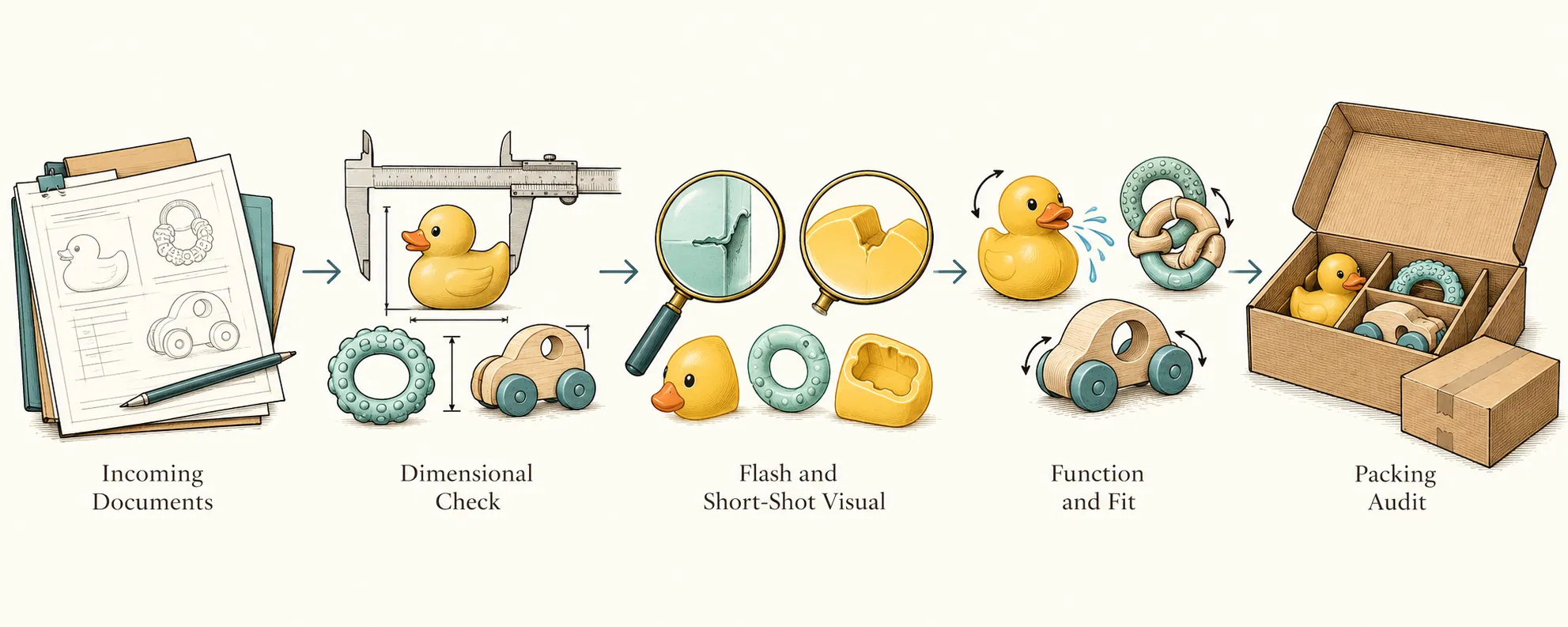
For the rainbow stacker, request the material of each part, surface finish, dimensions, included pieces and assembly arrangement. Observe surface condition and how the pieces fit during sample review. Record those observations as commercial quality checks—not as a substitute for applicable safety testing.
Material feel belongs in the sample record: describe the observed texture, flexibility and finish of the identified sample. A single catalog material field does not establish the feel or construction of the whole toy.
How should US/EU buyers reconcile report coverage?
Evaluate report coverage against the selected construction, intended use, age scope and destination—not against a generic certificate heading. Keep the US and EU review decisions separate when the assortment will serve both markets, and name the reviewer responsible for each.
Request the complete report and compare its model references, photographs, component descriptions, tested variants, applicable standard editions and results with the controlled specification. Document any explanation linking a report model to the buyer’s item.
A different internal item number does not automatically invalidate a report, and a matching name does not establish coverage. Review construction changes, applicable retesting duties and retailer policies separately; do not impose a universal report expiry or assume every later batch needs a new report.
If a material, finish, attachment or care instruction changes, route that change back to the technical reviewer. The decision record should identify what changed, which evidence remains applicable and what additional evaluation is required before release.
Which candidates should enter the next decision record?
Advance the teething ball and rainbow stacker to clarification, not PO approval, and keep any bath-toy candidate in scope-definition review until its own item-specific package is assembled.
The entries below are recommended intake dispositions as of October 27, 2026, not claims of completed supplier or buyer approvals. A proposed clarification checkpoint is January 4, 2027; the purchasing gate remains closure of the relevant conditions before PO release, regardless of the fair calendar.
| Sensory teething ball — recommended disposition | Status: advance to technical and commercial clarification only. Proposed accountable owner: category buyer, with product-safety reviewer acceptance. Intake baseline: October 9, 2026 catalog reference. Approval target: the supplier’s controlled construction specification and identified sample; record the exact revision at sign-off. Open conditions: component-level material mapping, proposed age and use evidence, care instructions, draft artwork, carton quantity and current quotation. Closure: link the accepted records, record the named approver and actual approval date, and resolve or explicitly restrict each condition before PO release. |
|---|---|
| Rainbow stacking toy — recommended disposition | Status: advance to specification clarification only. Proposed accountable owner: category buyer, supported by quality and destination-market reviewers. Intake baseline: October 9, 2026 catalog reference. Approval target: a controlled specification identifying the material and finish of each part, dimensions, pieces and sample; record its exact revision at sign-off. Open conditions: construction details, proposed age evidence, care instructions, draft artwork, current quotation and confirmation of the recorded carton quantity. Closure: record the accepted observation against each target, the named approver and actual approval date before PO release. |
| Baby bath-toy candidate — intake requirement | Status: scope definition before purchase approval. Proposed accountable owner: bath-assortment buyer. Identify the actual item and supplier model, destination market, proposed age band, wet-use construction, cleaning and drying method, sample and specification revision. Assemble its own pre-PO package; do not borrow the teething ball’s material reference or either example’s commercial terms. |
| Decision and follow-up closure | For every candidate, record the specified target beside the observed sample or document detail. Choose an explicit disposition: approve, approve with defined restrictions, or hold. Assign a named owner and due date to each action; close it with the replacement document revision or observation, reviewer name and closure date. If a restriction remains, carry it into the PO and release instructions. |
Which records belong at the final shipment handoff?
Collect shipment-specific records after the order and actual packing details exist; do not make a final packing list a prerequisite for opening an RFQ. Before the PO, agree the packing specification. At shipment preparation, reconcile the actual shipment against that agreement and the approved product revision.
Keep final production artwork and any approved changes linked to the decision record. A traceable file helps reviewers follow approvals, but it does not by itself prevent or reveal an undisclosed production change.
| Commercial invoice | Owner: supplier commercial or export contact. Reconcile the PO reference, buyer and seller details, item descriptions, quantities, prices, currency and agreed terms. Resolve differences with purchasing before shipment authorization so the commercial record reflects the accepted order. |
|---|---|
| Final packing list | Owner: supplier packing or shipping contact. Check actual item quantities, units per carton, carton count, carton marks, dimensions and identified gross and net weights against the agreed packing specification. Investigate a mismatch rather than replacing actual packing data with catalog values. |
| Inspection and release record | Owner: buyer quality reviewer or appointed inspector; purchasing records the release decision. Identify the PO, item, approved specification and artwork revisions, inspected lot or sample, observations, deviations and corrective-action closure. Record who authorized release and when. Commercial inspection does not replace safety testing or destination-document review. |