Quick answer
To choose Montessori-inspired toys for retail, look for a clear, repeatable action such as grasping, stacking, sorting, fitting, carrying or building. Then review the material, finish, dimensions, age guidance, pack format, care instructions and market-specific document needs. Montessori is not a certification or a guarantee of a developmental result. For a wholesale buyer, the best product story is specific, easy for retail staff to explain and consistent across the range.
What should Montessori mean in a buyer brief?
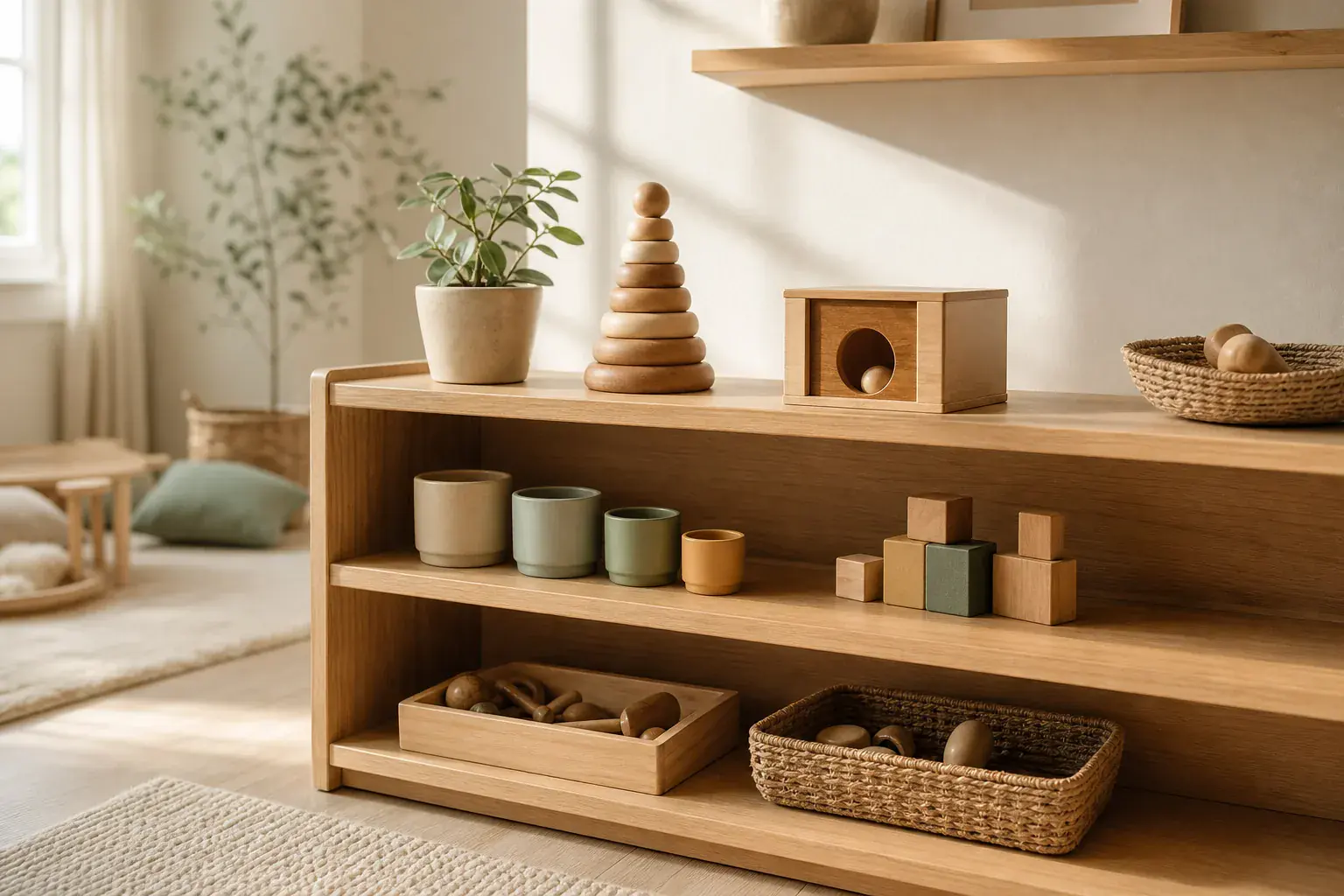
Montessori-inspired is most useful as a design direction, not as a certification claim. It often points to simple materials, clear actions, open-ended use and a calm shelf story. A buyer should still describe the actual product rather than relying on the label alone.
Ask what the child can do with the item, how the adult introduces it and how the product should be stored, cleaned and packed.
Which actions make a learning product easy to understand?
Open-ended learning formats often have one obvious starting action: grasp, stack, sort, fit, carry, thread or build. The action should be clear enough for a retailer to explain in a sentence and flexible enough to support more than one play arrangement.
- Grasping and transferring pieces.
- Stacking, nesting or balancing.
- Sorting by shape, size or color.
- Fitting, building or arranging a simple scene.
How should materials and finish be compared?
Material details should be specific. For wood, ask about the wood type, coating, paint or finish. For silicone, plastic or fabric, ask about the material, surface, construction and care. A buyer needs enough information to compare options across suppliers and to write accurate pack copy.
Finish, dimensions, edges, attachments and packaging should be reviewed together because a change in one may change the product conversation.
What are STEM toys and where do they fit?
STEM toys are usually framed around science, technology, engineering or mathematics ideas through making, testing, building, sorting or problem-solving. For an early-learning buyer, a simple construction or city-play concept can sit beside Montessori-inspired formats when the action and age story are clear.
Use observable wording such as build, sort, connect or test. Do not promise a learning outcome or use a school or expert endorsement that has not been verified.
How should age and packaging be planned?
Age bands help a buyer organize the shelf, but the product's approved age guidance comes first. Decide whether the pack is retail-ready, a gift set, a classroom pack or a bulk carton. Make the illustrations and instructions match the finished product and destination market.
- Set the target age band and sales channel.
- Choose the play action and material story.
- Review dimensions, finish, care and attachments.
- Confirm pack quantity, carton plan, MOQ and timing.
What should a buyer ask before approving a range?
Ask for sample details, material and finish information, packaging direction, QC checkpoints, care notes and the applicable document discussion. A responsible supplier conversation is more useful than a broad claim that a product is educational or developmentally beneficial.
See the Montessori toys wholesale category and include your market and quantity in an RFQ.
Buyer worksheet
Turn this learning guide into an RFQ.
This guide is a starting point for buyers comparing how to choose montessori toys. The next useful step is to translate the idea into the product facts and commercial details a supplier can review. Keep the intended customer, market and sales channel visible, then connect the article's question to the selected product record rather than treating a broad category label as a specification.
Product brief
Name the action and age band.
Describe what the child is expected to hold, shake, squeeze, sort, stack, build, wash or explore. Add the intended age guidance, dimensions, material, finish, attachments and care question you want answered.
Commercial brief
Make the quantity useful.
Share the target quantity, pack direction, carton preference, destination, sales channel and timing. Ask for MOQ, FOB assumptions, carton quantity, lead time and sample steps by selected SKU.
Approval brief
Keep the record together.
Before approval, compare the sample, product information, packaging copy, QC checkpoints and market-specific document discussion. Record what is confirmed, what is estimated and what still needs review.
Questions to carry into the next conversation
- Which product or category should answer the buyer's need, and what observable play action supports that choice?
- Which material, finish, construction, attachment, care or packaging detail could change the decision?
- Which age band, customer and destination market should the product information address?
- Which MOQ, carton plan, timing and FOB details should be included in the comparison?
- Which documents, labeling points or QC checkpoints need confirmation before an order?
Use the category pages to narrow the range, the wholesale page to organize quantity and logistics, the safety and quality page to frame product questions, and the RFQ form when you are ready to share the brief. A focused message is useful even when some answers are still open; it gives the team a clear starting point for the next question.
When the first response arrives, review it as a working document. Mark which product facts came from the approved record, which commercial values are estimates and which questions need a sample, packaging file, inspection step or destination-market review. This separation helps a merchandising team compare options without losing the quality and logistics details that matter later.
For repeat orders, save the final SKU, material, pack, carton information, care wording and approved reference with the quotation. If a buyer wants a new color, private-label package, mixed carton or larger quantity, compare the request with that reference and ask which parts of the original approval need to be revisited.