
For a baby bath spray water toy, confirm the spray action for the bath-play slot, then record MOQ separately from retail packaging and shipping-carton quantities. MOQ answers how much the supplier will accept; packing answers how the product is presented and shipped. Apply the same separation to teething and wooden-toy assortment lines. Convert quantities only after confirming whether the minimum means individual toys, retail sets or cartons—and never treat a carton count as an automatic order multiple.
Choose the play function before comparing minimums: a spraying bath toy, a bath animal set, a teething product and a wooden floor-play toy serve different assortment roles. A lower reference MOQ does not make them substitutes.
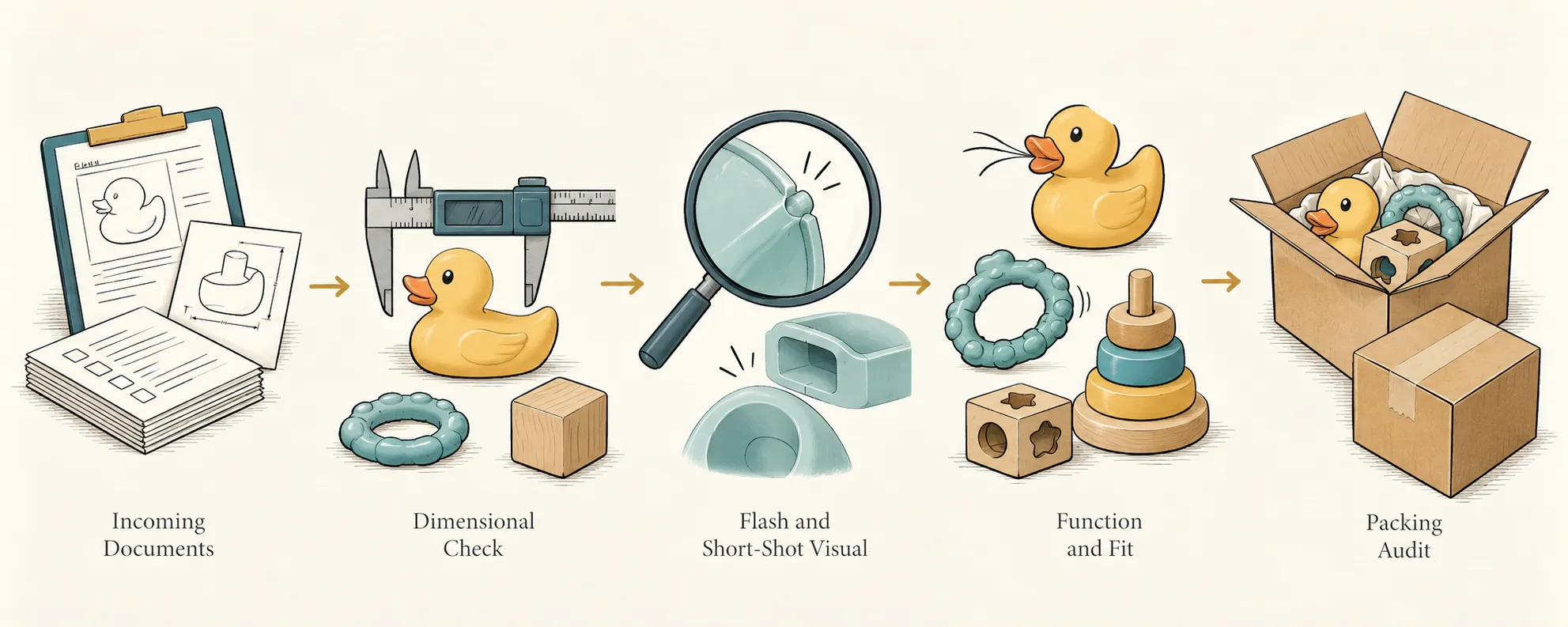
Which questions concern MOQ, and which concern packing?
A question concerns MOQ if its answer changes the minimum purchase commitment; it concerns packing if its answer describes the retail unit or shipping configuration.
On the MOQ side, ask: “What is the minimum, in what unit, and does it apply per product, per variant or across an agreed assortment?” Keep any required order increment in a separate field. A minimum of 120 units does not, by itself, mean orders must be multiples of 120.
On the packing side, ask: “What does the customer receive, how many retail units fit in a shipping carton, and are partial or mixed cartons accepted?” A retail set can contain several toy pieces, so define the sellable unit before counting either MOQ or carton contents.
Do not combine bath, teething and wooden-toy quantities to clear a minimum unless the supplier explicitly accepts that mixed-assortment basis. Sharing a purchase order is not the same as sharing an MOQ.
Educational Bathtub Toy
| MOQ side | Reference MOQ: 120. Request a current quote stating whether this means individual retail units, sets or cartons, and whether it applies per product or variant. |
|---|---|
| Packing side | Retail packaging: window box. Recorded units per carton: 24. Confirm what one counted unit contains and whether partial or mixed cartons are accepted. |
| Product identity to retain | Educational Bathtub Toy; recorded material: ABS; window-box configuration. Tie the quote and sample to this same configuration. |
Dinosaur Bath Animal Set
| MOQ side | Reference MOQ: 36. Ask whether each counted unit is one complete retail set and whether the minimum applies to each assortment or variant. |
|---|---|
| Packing side | Recorded packing: single item. Request a packing photo, the contents of one retail unit and the number of retail units per shipping carton. |
| Product identity to retain | Dinosaur Bath Animal Set. Match the sample contents and material specification to the quoted retail unit before comparing its quantity commitment with the bathtub toy. |
What can you calculate from the two worksheets?
If the reference minimums are confirmed as retail units, the bathtub toy starts at 120 units and the dinosaur bath set starts at 36 units; carton data determines shipment breakdown, not whether a unit-based minimum can be understood.
For the bathtub toy, 120 units ÷ 24 units per carton = five cartons. There is no carton remainder at that quantity. This calculation is conditional on the quote confirming that MOQ units and carton units count the same retail package. It does not establish a five-carton ordering rule.
For the dinosaur bath set, a confirmed 36-retail-unit MOQ would establish the minimum unit commitment. Request units per shipping carton before calculating its carton breakdown. Do not interpret “single item” as one unit per shipping carton.
Multiply MOQ by carton contents only when the MOQ is explicitly expressed in cartons or cases. A unit-based minimum is already a unit quantity; multiplying it by units per carton would overstate the commitment. The case-based conversion principle is illustrated by Stockwik.
Neither catalog entry establishes an order multiple. For a proposed quantity above the minimum, ask whether that exact quantity is acceptable before rounding it to a full carton.
When does a packing change become an MOQ question?
A packing change becomes an MOQ question when the supplier sets a different minimum for the revised configuration; record both the new packaging specification and its separate commercial threshold.
Keep the standard window-box option as one quote line and a proposed gift-set or custom-printed option as another. Request the minimum for the finished packaged product and ask whether any separate packaging-production minimum applies. Do not carry the standard-product minimum into the revised option without confirmation. CBME identifies packaging format and customization as separate MOQ questions in its supplier checklist.
Use this distinction across the assortment. For a teething line, define whether the retail unit is one product or a multipiece set. For a wooden-toy line, distinguish the pieces inside a retail set from the sets inside a shipping carton. Request separate MOQ confirmation for changes to color, material or pack format; customization minimums can differ from standard-order minimums.
Do not create a bath-and-teething gift bundle merely to combine quantities on paper. Treat the bundle as a separate packing proposal and ask which minimum applies to that finished configuration.
What must be recorded before approving the assortment quantities?
Approve an assortment line only against a defined retail unit, a current MOQ basis and an explicitly accepted order quantity; keep sample and destination-document review as separate approval conditions.
Use one record per quoted configuration. Identify the product, supplier, sample reference, quote date and revision. Place the requested target beside the supplier’s quoted answer or sample observation: order quantity, MOQ scope, retail-unit contents, pack format, carton quantity and any explicit order increment.
Carry these focused requests into follow-up: the buyer obtains the current quote and MOQ basis; the packaging or logistics owner confirms retail-unit and carton counts; the product reviewer checks the sample’s intended mechanism and contents; the compliance reviewer assesses age evidence and documents for the intended destination. Assign a named owner and due date to each request.
Record the decision as approved, approved with stated conditions, or held. Add the responsible approver and approval date, then close each condition with the response or document reference and closure date. A changed pack, variant mix or MOQ basis should be reflected in the revised approval record.
The final buying comparison should show the accepted unit commitment separately from the shipment configuration. Choose the configuration that fits the assortment quantity and presentation—not the one whose MOQ and carton numbers happen to look alike.