
A nursery buyer opening a carton of 500 newborn teether toys faces three questions before the first pallet ships: does the ring fit a 0–6 month hand and mouth, can it be cleaned the way AAP guidance expects, and does every part clear the CPSC small-parts cylinder at 16 C.F.R. § 1501.4. birth-through-6-month toy list names large rings, rattles, squeeze toys, and teething toys as objects babies reach for, hold, suck on, shake, and mouth, which sets the developmental target for the category.
The regulatory target is narrower than the shelf story. A small part is any object that fits, without compressing and in any orientation, entirely into the small parts cylinder, and it can be a whole toy, a separate part, or a piece that breaks off during use-and-abuse testing. Teethers are not on the 16 C.F.R. § 1501.3 exclusion list that covers rattles and pacifiers, so a ring cannot borrow rattle-style exemption. This guide maps stage, geometry, phthalates, tracking labels, and cleanability into one purchase-order structure for newborn teether toys.
Stage first: what a 0–6 month mouthing toy must do
parenting content describes play for very young children as exploration and lists reaching for and holding a baby-safe object as a first-month activity that practices opening and closing fists. young-infant list, covering birth through 6 months, names large rings among the things babies can reach for, hold, suck on, shake, and make noise with. That is the functional brief for a newborn teething ring: it must be catchable by a hand that is still learning to close, and mouthable by a baby who puts objects in the mouth as part of exploration.
AAP guidance adds the matching rule: the best toys match a child's developmental skills and encourage new skills. WHO's 2019 guidance for infants under 1 year recommends physical activity several times a day, including at least 30 minutes of prone tummy time spread across the day while awake, and no screen time. A teether that a baby can hold during floor play and tummy time fits that 30-minute daily window better than a toy that needs a caregiver to hold it.
Translate the stage into a written spec rather than a mood board. The purchase order should state the age band (0–6 months or 6 months+), the intended grasp (palmar grasp of a ring), the mouthing role (sucking and teething), and the play context (floor play, stroller, diaper bag). Those four fields drive every downstream test: small parts, phthalates, tracking label, and cleaning instructions.
Ring geometry and grasp ergonomics for newborn hands
The sources give no age-graded ring dimensions, thickness, or texture numbers, so geometry is a buyer specification, not a sourced mandate. Build it from three observable facts: lists large rings for birth through 6 months; AAP advises that all toys and parts be larger than the child's mouth to prevent choking; and describes early reaching as practice in opening and closing fists. A ring that is too thin slips out of a palmar grasp; a ring that is too thick cannot be brought to the mouth by a 3-month-old.
Write the geometry as a three-line spec. Line 1: outer diameter and ring thickness, recorded in millimeters on the drawing. Line 2: opening size, measured at the narrowest point, with a note that the opening is not a separate part. Line 3: surface texture, specified as smooth, ribbed, or dimpled, with the rib depth in millimeters. Keep the same drawing revision on the PO, the CPC file, and the tracking-label batch record so a later mold change cannot silently alter the cylinder result.
Texture serves mouthing comfort, not decoration. A ribbed ring gives a baby a different feel from a smooth ring, and the AAP guidance on sturdy plastic toys that do not break easily into sharp pieces applies to every rib and seam. Specify wall thickness at the rib root and require the use-and-abuse test to cover the ribbed section, not only the plain arc of the ring.
One-piece versus multi-part: where the small-parts boundary sits
The CPSC small-parts rule is a geometry test, not a marketing claim. A small part is any object that fits, without compressing and in any orientation, entirely into the small parts cylinder at 16 C.F.R. § 1501.4, which approximates the fully expanded throat of a child under three. The rule counts three cases: a whole toy, a separate part, and a piece that breaks off during testing that simulates use or abuse by children. A one-piece molded ring can still fail if a rib snaps off in abuse testing and the fragment enters the cylinder.
The exclusion list is where purchase orders go wrong. 16 C.F.R. § 1501.3 excludes rattles as defined at 16 C.F.R. § 1510.2 and pacifiers as defined at 16 C.F.R. § 1511.2(a), along with balloons, books, writing materials, clothing, feeding and hygiene products, and modeling clay. Teethers are not on that list. A multi-part rattle-teether cannot claim the rattle exclusion for its teething end, and the buyer should confirm which standard the item is certified against rather than assuming rattle-style exemption carries over.
The PO fix is a construction declaration. Require the factory to state one-piece molded, two-piece assembled, or multi-part with attached elements, and to list every separable element by name and material. For each element, attach the cylinder result and the abuse-test result. For a one-piece ring, the declaration still needs the abuse-test result because the broken-off case applies to a single molded body.
Phthalates: the 1000 ppm limit and which components count
Section 108 of CPSIA, codified at 15 U.S.C. § 2057c and 16 C.F.R. part 1307, bans children's toys and child care articles containing more than 0.1% (1000 ppm) of eight listed phthalates in an accessible plasticized component. The eight are DEHP, DBP, BBP, DINP, DIBP, DPENP, DHEXP, and DCHP. The definition of child care article explicitly includes products designed to help children age 3 and younger with sucking or teething, which places a soft teething grip squarely inside the rule.
Component count is the practical issue. A rigid ring and a soft grip are different accessible plasticized components, and each needs its own result. A single toy-level statement does not cover both. CPSC also notes that a testing exemption for certain listed materials does not exempt a firm from meeting the 0.1% requirement, and a firm may still be held responsible if the end product contains a regulated phthalate above 1000 ppm.
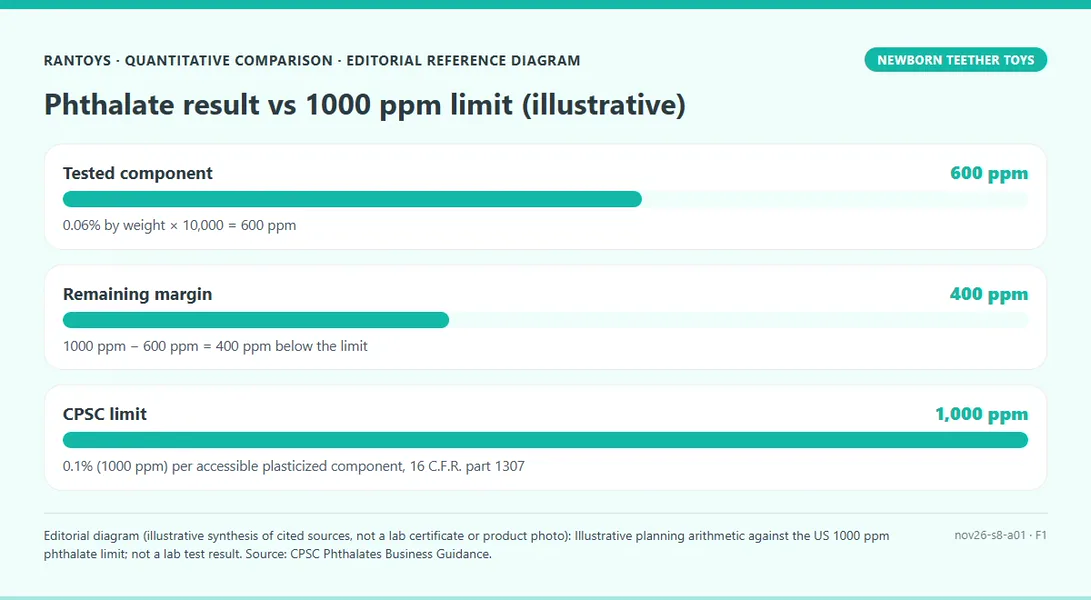
Illustrative planning example, not a lab test or a price quote: a buyer receives a result of 0.06% total regulated phthalates by weight for one accessible plasticized component. Convert to ppm by multiplying by 10,000: 0.06 × 10,000 = 600 ppm. The margin to the limit is 1000 − 600 = 400 ppm, so the component sits at 60% of the 1000 ppm threshold. That 400 ppm cushion applies only to the tested component; every other plasticized part of the teether needs its own result before the toy is approved.
One-piece molded ring vs multi-part rattle-teether: buyer comparison
Use this table to write the construction declaration and the test file for each SKU. Each row ties a purchase-order field to the CPSC rule that governs it.
| Attribute | Governing rule | One-piece molded ring | Multi-part rattle-teether |
|---|---|---|---|
| Small-parts exposure cases | 16 C.F.R. part 1501 | Whole ring and any piece broken off in use-and-abuse testing must clear the 16 C.F.R. § 1501.4 cylinder | Whole toy, each separate part, and each broken-off piece must clear the same cylinder |
| Rattle/pacifier exclusion | 16 C.F.R. § 1501.3, § 1510.2, § 1511.2(a) | Not on the 16 C.F.R. § 1501.3 exclusion list; no rattle-style exemption | Rattle exclusion applies only to the rattle as defined at 16 C.F.R. § 1510.2, not to the teething end |
| Phthalate components to test | 16 C.F.R. part 1307 | Each accessible plasticized component, including any soft overmold, at 1000 ppm | Each accessible plasticized component across ring, grip, and attached elements at 1000 ppm |
| CPC citation in section 2 | CPSC CPC guidance | "16 CFR part 1501 – Small parts" and "16 C.F.R. part 1307 – Phthalates" | Same two citations, plus any other applicable rule for attached elements |
| Tracking label placement | 15 U.S.C. § 2063(a)(5)(A) | Visible, legible, permanently affixed to product and packaging to the extent practicable | Same, with batch or run number tying every attached element to one production run |
| Cleanability spec | AAP toy-safety guidance | Smooth, closed surface with no seam cavity; state wash method in the care instruction | Seam and joint count listed; confirm no loose ribbons or strings and machine-washable construction where claimed |
Cleanability: what the sources support and what they do not
AAP toy-safety guidance supports a cleanability spec built on well-made construction: parts on tight, seams and edges secure, machine-washable stuffed toys, no loose ribbons or strings, and sturdy plastic that does not break easily into sharp pieces. The cited sources give no teether-specific cleaning standard, so a care instruction such as "wipe with a damp cloth" or "wash in warm water" is a brand specification, not a sourced mandate. Write the method, the temperature, and the drying step on the care label and repeat them in the retail listing.
Construction choices drive the claim. A one-piece molded ring with a closed surface has no seam cavity to trap residue, while a multi-part rattle-teether adds a joint that needs its own cleaning instruction. If the teether includes a fabric tag or ribbon, AAP guidance to remove loose ribbons or strings applies directly, and the safest PO line is to specify no loose ribbon at all.
Are teething rings exempt from the small-parts ban like rattles and pacifiers?
No. Teethers are not listed in the 16 C.F.R. § 1501.3 exclusion set, which covers rattles as defined at 16 C.F.R. § 1510.2 and pacifiers as defined at 16 C.F.R. § 1511.2(a) along with balloons, books, writing materials, clothing, feeding and hygiene products, and modeling clay. A teething ring must clear the 16 C.F.R. § 1501.4 cylinder as a whole toy, as a separate part, and as any piece that breaks off in use-and-abuse testing.
What phthalate limit applies to a soft teething grip, and which parts must be tested?
The limit is 0.1% (1000 ppm) for each of eight listed phthalates in an accessible plasticized component under 16 C.F.R. part 1307. Every accessible plasticized component needs its own result, because a child care article definition explicitly covers products that help children age 3 and younger with sucking or teething. A rigid ring and a soft grip are separate components, and a single toy-level statement does not cover both.
Does a Children's Product Certificate cover the tracking label on a teething toy?
No. CPSC states the tracking-label requirement is not a safety rule requiring certification, so the CPC does not need to reference tracking labels. The tracking label is a separate checkpoint: visible, legible, permanently affixed to product and packaging to the extent practicable, showing manufacturer or importer name, location and date of production, and batch or run number. The CPC carries the safety citations, including "16 CFR part 1501 – Small parts" and "16 C.F.R. part 1307 – Phthalates".
Build the teether PO around four checkpoints
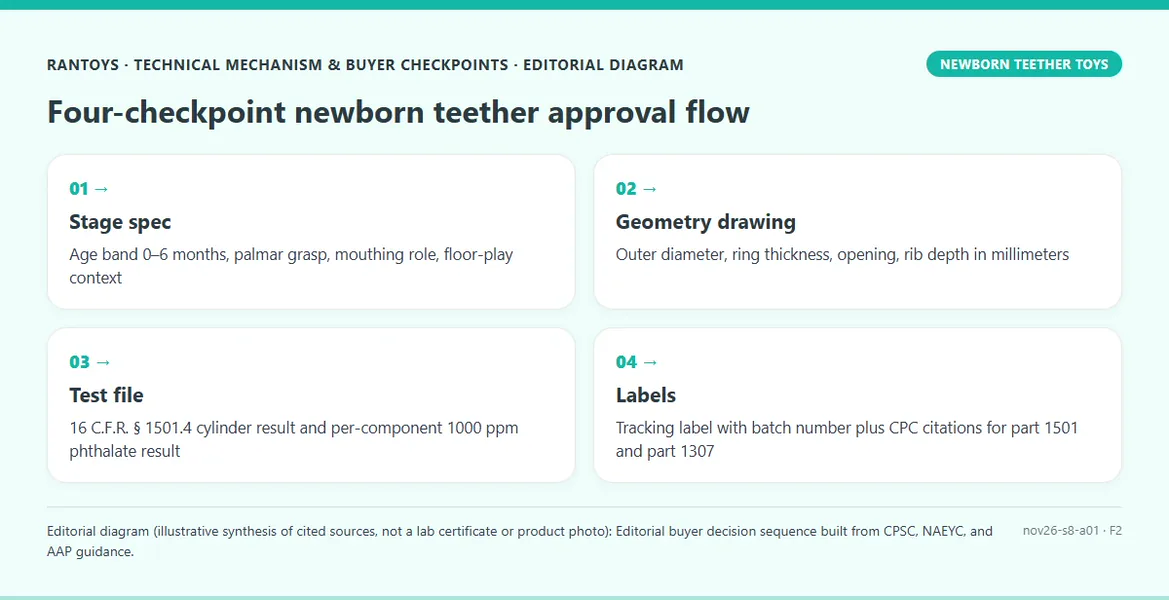
Write the newborn teether PO around four checkpoints: the stage spec (0–6 months, palmar grasp, mouthing role), the geometry drawing with millimeter dimensions, the cylinder and phthalate results per component, and the tracking label tied to the batch number. RanToys self-reports 14 years in business since 2012, a 500-piece minimum order, a 25–35 day lead time, 300+ staff, 9 production lines, 500,000 pcs monthly capacity, exports to 80+ countries, and EN71/ASTM certifications; treat those as brand claims and pair them with the test documents for each SKU.
Start from the RanToys baby toy catalog and request the construction declaration, the cylinder result, and the component-level phthalate report before approving any newborn teething ring.
Sources
www.cpsc.gov — Small Parts Ban and Choking Hazard Labeling | CPSC.gov