
Use unpacked product dimensions to describe the toy in use, and packed dimensions to plan the space occupied by its saleable package. For a baby bath spray water toy, measure the operating configuration rather than a squeezed or folded packing state. Apply the same distinction to teethers and wooden toys: compare usable size for assortment presentation, packaged size for shelf fit, and a separately measured master carton for shipment planning. Never substitute one measurement basis for another.
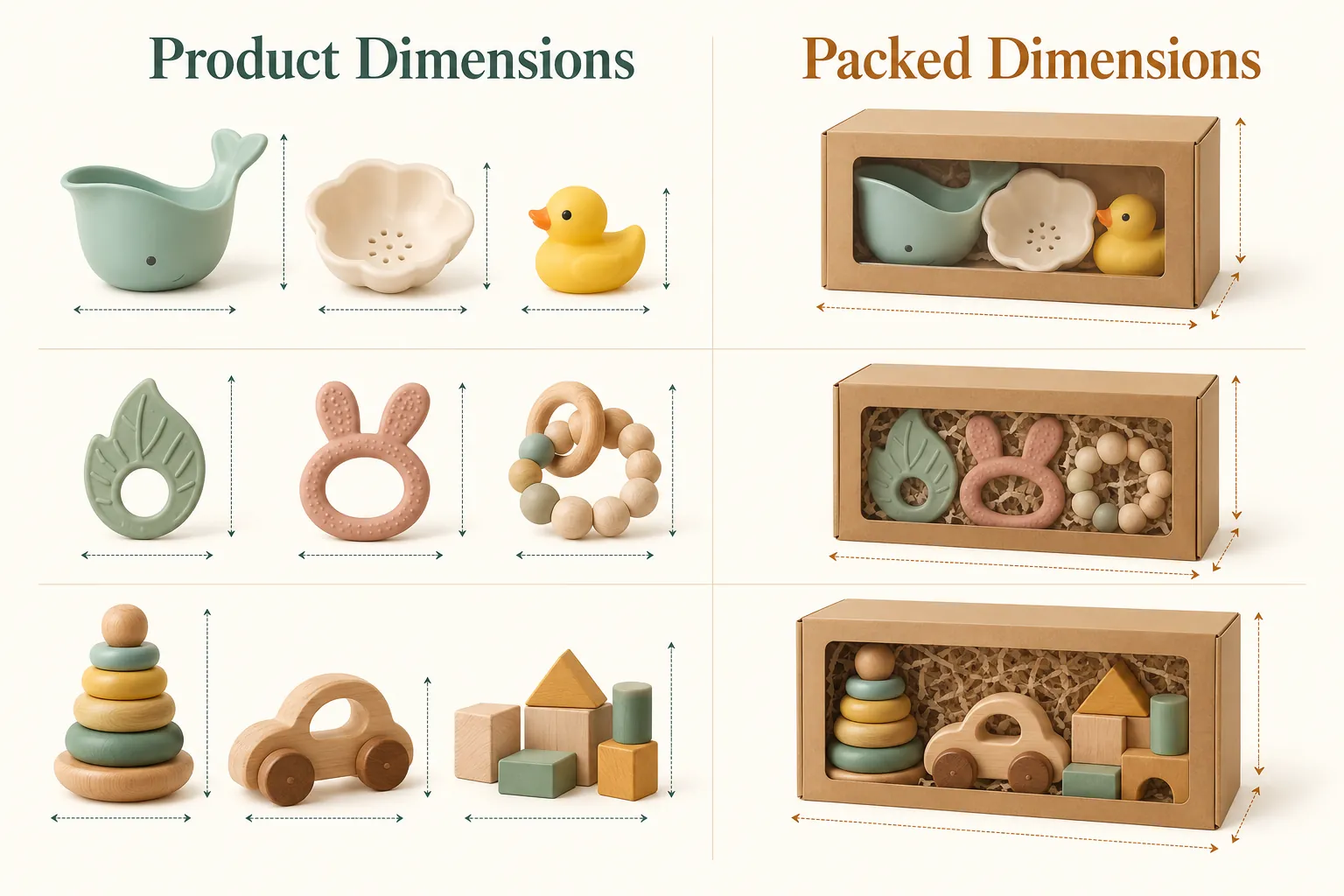
What does each dimension field actually measure?
Product dimensions measure the unpacked toy in a defined usable configuration; packed dimensions measure the complete packaged sale unit. Keep the shipping carton as a third, separate record.
In an Amazon Seller Forums discussion, a moderator distinguishes the functioning, unpacked product from the product in its preparation and product packaging. That supports the distinction between the two fields in that marketplace context—not a universal freight-pricing rule. Amazon Seller Forums
Use the following two-column comparison when preparing samples. The left column describes the usable product; the right describes its packed sale unit.
| Bath spray toy: measure the body in its normal operating shape, including fixed protrusions. Identify any removable attachment included in the measurement. | Measure the closed sale package with the toy and included accessories inside. Include preparation materials when that is the required receiving configuration. |
|---|---|
| Teether: measure the unpacked item without squeezing or stretching it. For a multipiece offer, record each distinct piece and identify the contents of one sale unit. | Measure the complete pouch, card or box as supplied. Do not use one teether's dimensions as the dimensions of a packaged set. |
| Wooden toy: specify whether dimensions describe an individual piece, an assembled toy or a stacked configuration. Record a play-layout footprint separately when useful. | Measure the closed package with all pieces and inserts in place. A stacked product height is not a substitute for the box height. |
| Assortment comparison: compare unpacked measurements only when the configuration and measured object match. | Compare packed measurements at the same packaging level: sale unit against sale unit, not sale unit against master carton. |
How should buyers measure consistently across an assortment?
Use one unit of measure and one clearly identified orientation throughout the assortment worksheet, then preserve the configuration in a measurement photo.
Millimeters are a practical working choice. Record length, width and height against an identified front or base, and show the measuring tool in the photo. If a listing channel requires a different axis convention, map the verified measurements into that convention rather than silently relabeling them.
For flexible bath toys and teethers, support the item without deliberately compressing it. For an assembled wooden toy, state the assembly used. Keep optional extensions or a spread-out play arrangement in a separate field so a compact storage configuration cannot masquerade as the usable size.
For packaged measurements, close the actual proposed pack and include the agreed contents, inserts and preparation materials. If the packaging changes, check the packed record again; the unpacked measurements may remain valid if the toy itself is unchanged. These are commercial measurement checks, not age-grading or safety tests.
How do the bath-toy and flashcard-machine catalog references compare?
The dinosaur bath-toy set and flashcard machine illustrate different packing descriptions, not a measured size comparison. Use the bath set for the bath-assortment example; use the flashcard machine only to show how a color-box entry should be handled.
The catalog references below are dated October 9, 2026. Their reference minimum order quantities are historical commercial entries, not current order guarantees. Neither a packing description nor an order quantity determines product dimensions.
| Dinosaur bath-toy set — catalog reference CPS282303 | Recorded packing: single item. Reference minimum order quantity: 36. Product-side action: identify every component in the sale unit and measure each distinct toy in its normal usable configuration. Packed-side action: confirm the actual sale packaging and measure its closed outer dimensions. Before release, confirm material description, intended age documentation and units per master carton. |
|---|---|
| Toddler flashcard machine — catalog reference CPS318048 | Recorded packing: color box. Reference minimum order quantity: 60. Product-side action: identify the operating configuration and measure the machine and any separately described components. Packed-side action: measure the closed color box with the agreed contents. Confirm material description, intended age documentation and units per master carton before release. |
| Bounded comparison decision | Do not rank either reference as smaller or more space-efficient from these packing descriptions. Request both measurement bases. A color box establishes a packaging format, not its dimensions; “single item” does not establish the set's component count or its outer packaging. |
What should the dimension approval worksheet contain?
Use one revision-controlled worksheet per sale unit, with specified targets beside observed measurements and separate decisions for product and packed dimensions.
Copy the fields below for each bath, teething or wooden-toy reference. Enter actual measurements rather than estimating from a catalog image.
| Identity and revision | Enter product name, internal reference, variant, sale-unit contents, sample identifier, packaging revision, worksheet revision and measurement date. |
|---|---|
| Usable product dimensions | Specified target: enter L × W × H and units, or approve an initial target from the sample. Observed: enter measured L × W × H. Identify the component, operating configuration, axis orientation and supporting photo. |
| Packed sale-unit dimensions | Specified target: enter maximum permitted L × W × H where a shelf or receiving limit applies. Observed: enter measured outer L × W × H. Identify pack format, contents, preparation materials, closure condition and supporting photo. |
| Master-carton record | Enter confirmed units per carton and measured outer carton L × W × H separately. Identify the carton configuration used; do not copy the sale-unit dimensions into this field. |
| Product-specific confirmation actions | Assign an owner and due date to each action: component count, material description, intended age documentation, packaging configuration or carton quantity. Close each action against the relevant confirmation or revised sample. |
| Approval sign-off | Record the decision for each measurement basis: approved, conditionally approved or held. State the approved use—product listing, shelf planning or shipment planning—plus conditions, responsible approver and approval date. |
| Follow-up closure | Record the completed corrective action, replacement sample or packaging revision, remeasurement result where applicable, closure owner and closure date. Identify which approval is released by that closure. |
Who approves the dimension record and against which basis?
The assortment buyer should approve the usable-product description, while the person responsible for packaging or receiving should approve the packed configuration and its intended space constraint.
Measure the unpacked sample first and identify what the customer actually receives. Then pack that same sale unit in the proposed packaging and measure it again. Review each observation against its own target: a suitable toy size does not compensate for a box that exceeds the available shelf space.
Approve the two bases separately. For example, if the product measurements are accepted but the box requires revision, retain the product approval and hold the packed-dimension approval until the revised pack is measured. Record the condition, owner and closure date instead of treating the entire record as either universally approved or universally unusable.
The worksheet provides traceability for what was measured and accepted. It does not, by itself, detect an undisclosed product or packaging change.