
A shopper lifts a wooden shape sorter off your floor display, drops the triangle piece on the tile, and hands the unit to a 2-year-old while the parent reads the carton. By closing time the same SKU has been handled 40 times, wiped twice with a disinfectant cloth, and lost one knob to the gap under the shelving. That is the real test for toddler toys in year-round retail: construction, cleanability and traceability, not the colorway on the planogram.
This buying guide works through three decisions a nursery merchandiser makes before signing a PO. First, does a bath or teething item have a sealed hollow body that traps moisture, or a solid or drainable construction staff can wipe between customers? Second, does a sorting or lock-and-latch floor item liberate small parts under 16 C.F.R. part 1501, and how many spare pieces does a carton need to keep the display complete? Third, does the carton and the product carry the four CPSC tracking-label data points, separate from the Children's Product Certificate?
RanToys supplies wooden baby toys, bath, Montessori, teething and soft plush lines with a stated 500-piece minimum, a 25–35 day lead time, EN71 and ASTM certifications, and exports to 80+ countries. Those figures set the ordering frame; the technical checks below set the approval frame.
Wipe-Down Hygiene: Separate Solid and Drainable Bodies From Sealed Hollow Cavities
Start with the failure mode that ruins a bath assortment. Cleveland Clinic pediatric guidance states that bath toys and other hollow toys often have small holes in the bottom that allow moisture in but do not easily let it out, making them a particular mold risk. A small mold spot can be wiped with warm soapy water or a little bleach, but a toy with obvious mold or a foul smell should be thrown away rather than salvaged. For a retailer, that means a returned bath pourer with a sealed body is not a cleaning task; it is a write-off.
The clinical stakes justify a strict spec. Mold allergies affect an estimated 3 to 10 out of every 100 people, and mold exposure can trigger coughing, wheezing, itchy eyes and asthma symptoms in sensitized children. Pediatric bathing guidance also recommends that tub toys be nontoxic and not have the potential to harbor mold, fungus and bacteria. A parent who reads that guidance will inspect the drain hole before buying, so the display sample must show a clean, dry cavity.
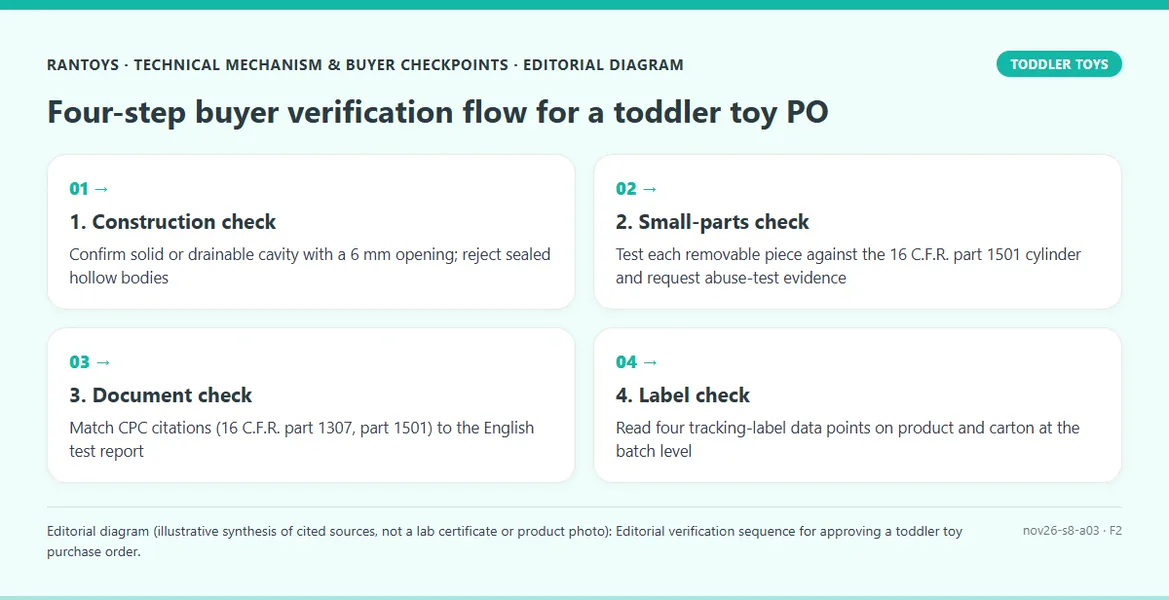
Write the cleanability spec as a physical check, not an adjective. For every bath pourer, teething ring and soft floor item, require that any cavity be fully drainable through an opening of at least 6 mm, so a 24-unit carton contains zero sealed hollow bodies that can trap water. Squeeze the sample: if water or air cannot exit freely, reject the construction. For teething rings, a solid one-piece molded ring passes; a two-piece shell with a pinhole vent fails. For soft plush with a squeaker, require a removable or sealed squeaker housing that wipes clean with a damp cloth.
Set the store routine around the same spec. Staff wipe floor and latch items with warm soapy water between customers, and bath samples get a 10-second drain-and-shake check at opening and closing. Any sample that smells foul leaves the shelf the same day, because the clinical guidance treats odor as a discard signal, not a cleaning challenge.
Replacement-Piece Risk: Small-Parts Logic for Sorting and Lock-and-Latch Floor Items
A toddler sorting cube with 6 shaped pieces and a latch board with 4 doors present two different risks. The shaped pieces are removable by design, so the buyer's question is whether each piece passes the small-parts cylinder and whether the display can survive a season of loss. Under 16 C.F.R. part 1501, children's products intended for use by children under 3 that present a choking, aspiration or ingestion hazard because of small parts are banned hazardous substances. A small part is any object that fits entirely into the small parts cylinder without compressing, including a piece that breaks off during use-and-abuse testing. The cylinder approximates the size of the fully expanded throat of a child under three years old.
That rule changes the assortment, not just the sample review. A shape sorter sold for ages 18 months+ must have pieces that either exceed the cylinder or are tethered so they cannot be mouthed separately. A lock-and-latch board with 4 hinged doors must show that the hinge pins and knobs do not liberate during use-and-abuse testing. The American Academy of Pediatrics gives parents the same rule in plain language: make sure all toys and parts are larger than the child's mouth to prevent choking, and check that parts are on tight and seams are secure.
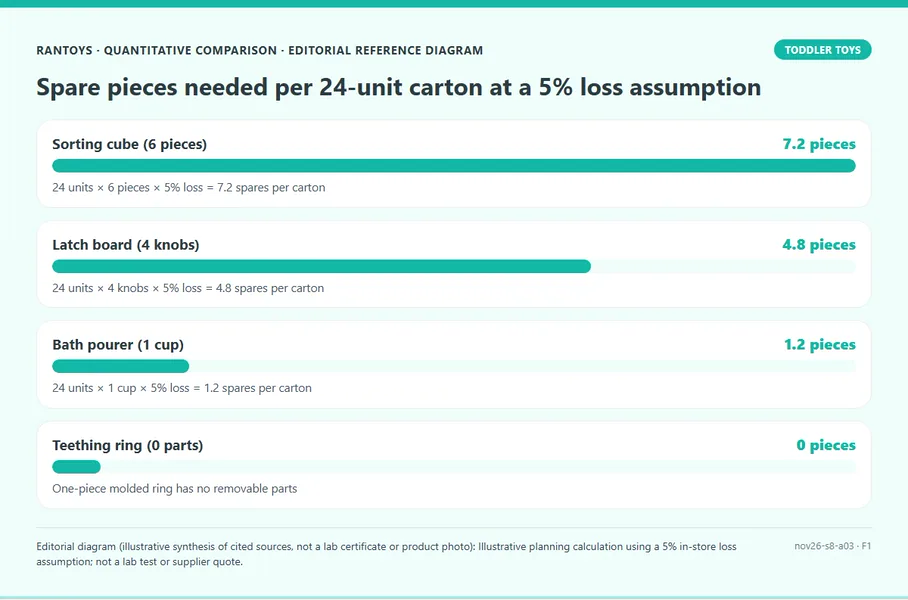
Now quantify the display. Illustrative planning calculation: take a toddler sorting or lock-and-latch floor item with 24 units per carton and 6 small removable pieces per unit. At a 5% assumed in-store loss or break rate, the carton holds 144 pieces (24 × 6), the expected loss is 7.2 pieces per carton, and a 10-carton trial needs 72 spare pieces (24 × 6 × 0.05 × 10 = 72). That is roughly 7 spares per carton, or one spare set for every 3.4 units. If the supplier cannot quote spares at that ratio, treat the SKU as a display-integrity risk before ordering.
Apply the same arithmetic to the latch board. A 4-door board with 4 removable knobs at 24 units per carton holds 96 knobs; at the same 5% loss assumption the trial needs 48 spares across 10 cartons. The buying decision is binary: either the carton ships with a spare-parts bag at the quoted ratio, or the SKU needs a tethered-parts design that removes the loss channel entirely.
Tracking-Label Verification: Four Data Points on the Carton and the Product
A carton that says 'CPSIA compliant' tells you nothing about recall traceability. The CPSC tracking label must be visible and legible, permanently affixed to the product and its packaging to the extent practicable, and must show four things: manufacturer/importer or private labeler name; location and date of production; detailed manufacturing-process information such as batch or run number; and other information to trace the specific source, such as the plant address. The information may be in code form as long as the consumer knows who to contact to interpret the code.
Verify each data point physically before approving a PO. On the carton, read the importer name, the production date in month/year or batch form, the run number, and the plant address or a code with a printed contact line. On the product, check the same four fields on the molded or printed mark. A wooden sorting cube with a sticker only on the shrink wrap fails the 'permanently affixed to the product' test; a teething ring with the batch number only on the master carton fails the packaging test.
The tracking label is not the safety certificate. The CPSC states the tracking label requirement is not a safety rule requiring section 14(a)(1) certification, so the CPC does not need to reference tracking labels, though a CPC is still required where other safety rules apply. Request two separate documents: a CPC citing applicable rules, and a photo or sample of the physical tracking label on product and packaging. A supplier who sends only a CPC has answered half the question.
Plan for the filing change. Beginning July 8, 2026, importers of most regulated consumer products will be required to electronically file certificates of compliance with U.S. Customs and Border Protection via a Partner Government Agency Message Set. A carton whose tracking data cannot be matched to the CPC citation will slow that filing, so the batch number on the label and the certificate must reconcile at the SKU level.
Four Toddler Item Types Compared by Care, Small Parts, Label Location and Spares
Use this table to set the approval checklist per item type. The spare-piece column applies the illustrative 5% loss assumption from the worked example to a 24-unit carton.
| Item type | Wipe-down method | Removable small parts | Trapped-moisture risk | Tracking-label location | Spare pieces per 24-unit carton at 5% loss |
|---|---|---|---|---|---|
| Wooden sorting cube (ages 18 months+) | Damp cloth with warm soapy water; dry immediately | 6 shaped pieces; each must exceed the small-parts cylinder or be tethered | Low if solid wood and water-based finish; high if hollow core | Permanent mark on base plus carton panel | 7.2 pieces |
| Lock-and-latch board (ages 2+) | Damp cloth; cotton swab at hinge recesses | 4 knobs and hinge pins; abuse-test evidence required | Low; open hinge geometry drains | Rear panel plus carton end | 4.8 knobs |
| Bath pourer (ages 6 months+) | Drain, shake and air-dry; wipe exterior with warm soapy water | 0 to 1 removable cup; check cylinder fit | High if sealed hollow body with a pinhole; low if fully drainable | Molded mark on base plus carton | 0 to 1.2 pieces |
| Newborn teething ring (0 to 6 months) | Warm soapy water wipe; no submerged hollow parts | 0; ring must be one molded piece | Low if one-piece solid; high if two-piece shell with vent hole | Tag or molded mark plus carton | 0 pieces |
Document Separation: CPC Citations Versus the Physical Tracking Label
A CPC is a certification, not a label. A children's product certificate must be based on test results from a third-party, CPSC-accepted laboratory, and the CPC and supporting test reports must be in English. For a toddler toy, the citation section should name each applicable rule. For phthalates, 16 C.F.R. part 1307 prohibits children's toys and child care articles containing more than 0.1% (1000 ppm) of eight listed phthalates in an accessible plasticized component, and the CPC citation is '16 C.F.R. part 1307 – Phthalates'. For small parts, the citation is '16 CFR part 1501 – Small parts', and the choking hazard warning label requirement does not need to be included in a CPC.
Build a three-document approval packet per SKU. Document 1 is the CPC in English with the product identification, each rule citation, the third-party lab identification, and the date and place of manufacture. Document 2 is the test report behind the CPC, showing the 0.1% (1000 ppm) phthalate result and the use-and-abuse small-parts result. Document 3 is the physical tracking label on product and carton, photographed at the batch level. A PO that lacks any one of the three is incomplete.
For EU-bound cartons, add the Toy Safety Directive 2009/48/EC file. The Directive sets essential safety requirements covering physical and mechanical, flammability, chemical, electrical, hygiene and radioactivity risks. Regulation (EU) 2025/2509 of 26 November 2025 requires all toys to have a digital product passport accessible via a data carrier, enters into force on 1 January 2026, and starts applying after a transition period of 4 and a half years on 1 August 2030. A carton shipped in 2026 still needs the Directive file; the passport requirement lands in 2030, so the sourcing calendar has a 4-year runway to add the data carrier.
Year-Round Carton Plan: Quiet Floor Play, Easy-Care Bath and Latch Items
Build the assortment in three tiers so the display stays complete across 12 months. Tier 1 is quiet floor play: wooden sorting cubes and latch boards, ordered at the 500-piece minimum with a spare-parts bag at the 7-per-carton ratio from the worked example. Tier 2 is easy-care bath and teething: drainable pourers and one-piece teething rings, ordered in 24-unit cartons with zero sealed hollow bodies. Tier 3 is soft plush and early-learning fill, ordered in smaller depth to refresh the shelf between the two hard-goods cycles.
Tie the order calendar to the stated 25–35 day lead time. A 10-carton trial of 240 units fits inside the 500-piece minimum when combined with a second SKU, so plan the trial as a mixed container rather than a single-SKU buy. play guidance for the first two years supports the assortment logic: reaching for a toy builds fine motor skills, and turning switches on and off demonstrates cause and effect, which is exactly the play pattern a latch board and a sorting cube deliver. Order the trial 35 days before the display reset, and hold the spare-parts bag at the store, not in the back room.
Do bath toys with small holes need to be rejected outright?
Reject any bath toy whose only opening is a pinhole that lets water in but not out. Cleveland Clinic guidance states that hollow toys with small holes in the bottom allow moisture in but do not easily let it out, making them a particular mold risk. Accept a bath pourer only when the cavity drains fully through an opening of at least 6 mm, or when the body is solid one-piece molded plastic.
What four things must a CPSIA tracking label show?
A compliant tracking label shows four data points: manufacturer/importer or private labeler name; location and date of production; detailed manufacturing-process information such as batch or run number; and other information to trace the specific source, such as the plant address. The mark must be visible, legible and permanently affixed to the product and its packaging to the extent practicable, and codes are allowed only when the consumer knows who to contact to interpret them.
Does a CPC cover the tracking label requirement?
No. The CPSC states the tracking label requirement is not a safety rule requiring section 14(a)(1) certification, so the CPC does not need to reference tracking labels. Request the CPC for the safety rules and a separate physical tracking label on product and carton; a CPC alone does not prove traceability.
Build the Trial Carton Around the Checks
Take the three checks into the next line review: a drainable-or-solid bath spec, a small-parts and spare-parts ratio for sorting and latch items, and a four-point tracking-label photo per batch. RanToys lists wooden baby toys, bath, Montessori, teething and soft plush lines with a 500-piece minimum, a 25–35 day lead time, EN71 and ASTM certifications, and 80+ export countries. Request the CPC citation list and the tracking-label photo for each SKU before the trial order is confirmed.
Sources
www.cpsc.gov — Small Parts Ban and Choking Hazard Labeling | CPSC.gov
www.cpsc.gov — Phthalates Business Guidance | CPSC.gov
www.cpsc.gov — Children's Product Certificate | CPSC.gov