Select a baby bath spray water toy for a water-action slot only after its sample demonstrates the specified spray mechanism; select teething and wooden stacking toys for separate mouthing and dry-play slots. Use a Written Confirmation Matrix to approve, conditionally approve, or hold each candidate against that role, rather than treating a catalog name as order approval. For the bath candidate below, require a functional sample check before specifying spray action on the purchase order.
Start with what the child is intended to do with the product, then attach the sample, commercial terms and destination review to that exact item. A material label helps identify a candidate; it does not establish the complete construction, suitable age or care method.
Which Candidates Should Advance in the Written Confirmation Matrix?
| Baby bath toy — water-action assortment slot | Catalog record: ABS; display box; reference MOQ 144 units; 48 units per carton. Target versus observation: the buying brief calls for spray action, while the recorded product description identifies a baby bath toy. Recommended disposition: HOLD for the spray-specific slot. Closure conditions: demonstrate the required water action on an identified sample, agree on cleaning and draining instructions, and confirm the current quote and pack configuration. If the action differs, reassess it as a different bath-play item rather than retaining a spray description. |
|---|---|
| 2-in-1 wooden stacking cups and color sorter — dry-play slot | Catalog record: wooden material; color box; reference MOQ 160 units; 80 units per carton. Target versus observation: stacking and color sorting are identified in the product name and match the proposed dry-play role. Recommended disposition: CONDITIONALLY APPROVE for sample evaluation, not order release. Closure conditions: verify the supplied components, stacking and sorting actions, surface finish, intended age labeling and care instructions against the selected sample; confirm current commercial terms. |
| Silicone teething toy set — teething slot | Catalog record: silicone; color box. Target versus observation: the description identifies a teething set, but the buyer must establish the exact contents and selling unit before comparing quantities. Recommended disposition: HOLD for order approval. Closure conditions: obtain an itemized pack-content list, current MOQ, units per carton and quote; review the sample construction, intended age labeling and cleaning instructions for the proposed teething use. |
| Plush sports bag play set — soft-play slot | Catalog record: plush; box packing. Target versus observation: the named sports bag play set offers a distinct soft-play concept rather than duplicating the bath or stacking role. Recommended disposition: CONDITIONALLY APPROVE the assortment concept only. Closure conditions: identify every included piece, confirm component materials and care instructions, obtain current MOQ and carton quantity, and complete sample and destination-document review before purchasing approval. |
What Must Each Sample Demonstrate for Its Assortment Slot?
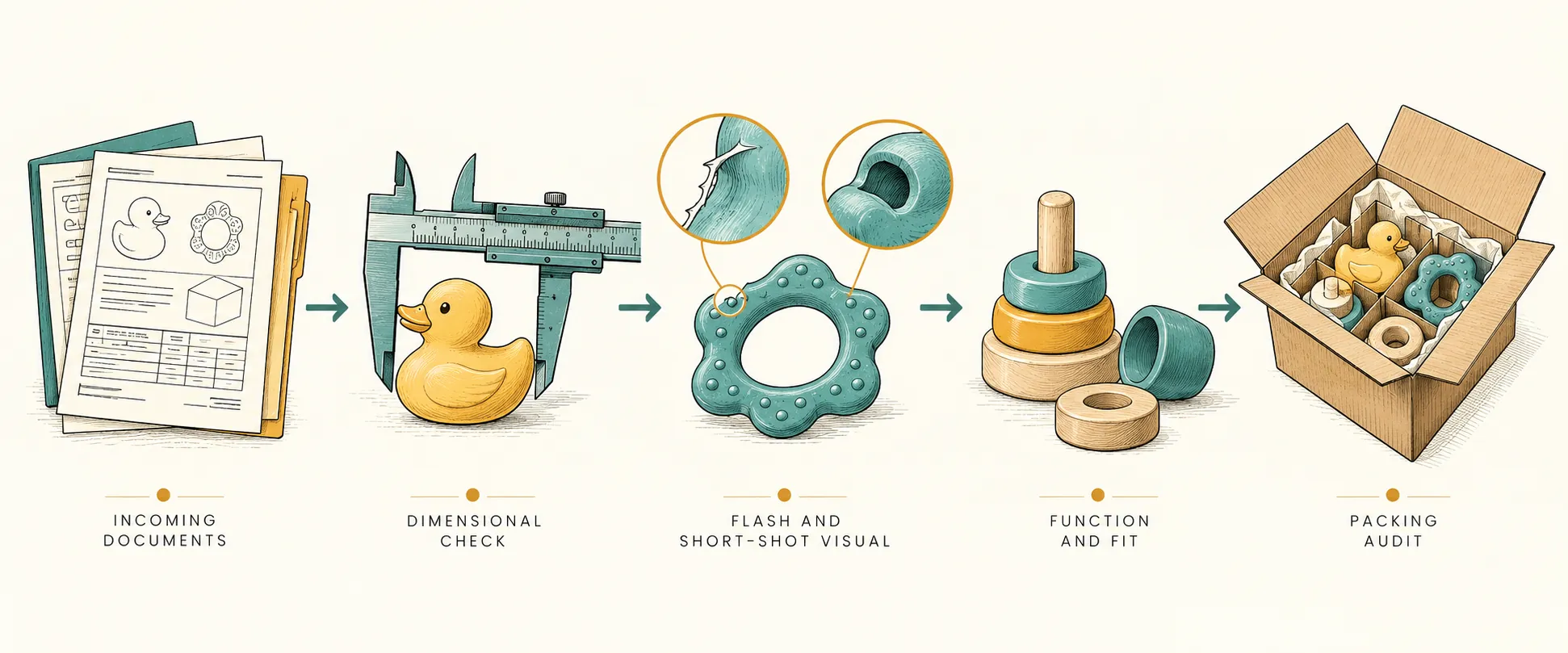
Each sample must demonstrate the intended play action and practical care method before the buyer accepts it for that assortment slot. These are purchasing observations, not substitutes for applicable product-safety testing.
For the bath candidate, write down the required activation method before testing: how water enters, what the user does to produce the action, and where water exits. Observe whether the sample performs that action and how it drains afterward. Request the supplier’s cleaning and drying instructions and compare them with the actual construction. Do not add squeeze, pump, battery or suction features to the specification unless the selected item has them.
The wooden sample needs a different examination. Assemble the supplied pieces, perform the stacking and sorting actions, and inspect accessible edges, surfaces and fit. Record the buyer’s observations alongside the agreed sample reference. Keep it in the dry-play slot unless the supplier’s item-specific instructions support another use.
For the teething set, reconcile every piece with the pack-content list and review the instructions for the intended mouthing use. Ask which components are silicone rather than assuming that one material field describes the entire set. Do not prescribe boiling, sterilizing or dishwasher cleaning without instructions that apply to the selected construction.
Handle the plush set as a separate soft-play product. Check the included pieces, seams and attachments, and review the care instructions. A plush catalog description is not a reason to position the set as an infant sleep-space accessory.
Record the proposed age band separately for every item. Do not apply one age label across the assortment simply because all four products sit in a baby-product category.
What Must the Written Confirmation Record Contain?
| Identity and revision | Record the supplier’s item identifier, descriptive product name, selected variant, matrix revision, catalog date, quotation revision and sample reference. Attach the intended destination market and proposed age band. |
|---|---|
| Specified target versus observation | Place the required play action, components, material description, packing and care requirements beside the sample observations and document references. Keep catalog entries distinct from sample findings and agreed order terms. |
| Commercial confirmation | Record the accepted selling unit, order quantity, current MOQ, carton quantity, price, currency and delivery terms from the agreed quotation. Request any order-multiple restriction separately; MOQ and carton quantity do not establish one. |
| Decision and conditions | Choose APPROVE, CONDITIONALLY APPROVE or HOLD. State whether the decision permits sample evaluation, assortment selection or order release. For conditional approval, describe the exact condition rather than writing a general instruction to confirm details. |
| Responsibility and approval date | Name the buyer responsible for commercial acceptance and the person responsible for product and destination review. Enter the actual approver’s name, decision date and scope of authorization when approval occurs. |
| Follow-up and closure | Give each condition an owner and due date. Close it with a dated sample finding, revised quote or reviewed document reference, then record the final release decision. Reopen affected conditions when the selected construction, contents or packing changes. |
When Does Conditional Approval Become Permission to Order?
Conditional approval becomes permission to order only after its stated release conditions are closed and the authorized buyer signs the relevant revision. Any accepted commercial exception should be explicit; it must not be used to waive applicable safety obligations.
For the bath row, use a condition such as: “Demonstrate the agreed spray action on the identified sample and accept the matching care instructions.” If the sample performs that action, enter the observation, sample reference, reviewer and date, then close that condition. The row still needs its commercial and destination-review conditions closed before order release.
If the sample instead pours water without producing the requested spray, keep the spray-specific decision on hold. Either choose another candidate or revise the assortment brief to a pouring-water toy and obtain fresh approval. Changing the product description silently would defeat the purpose of the matrix.
For the wooden row, retain the recorded reference MOQ of 160 units and carton quantity of 80 as catalog values until current terms are agreed. Apply the same distinction to the bath candidate’s reference MOQ of 144 and carton quantity of 48. A carton quantity is not automatically an order multiple.
Release approved lines individually if the buying plan allows it; an unresolved teething-set quantity need not invalidate a separately approved wooden item. The matrix provides traceability to what was reviewed and accepted. It does not, by itself, prevent an undisclosed product change.