
When two wooden activity toys look identical in a catalogue photo, what should your hands check at the fair? Compare the rim, the working fit and the way the assembled toy sits—not just the broad, photogenic face. A stacking cup and a peg board give you very different opportunities to feel how the finish meets the play action.
At the , use five observation fields: grain, edge radius, coating sheen, component fit and base stability. The goal is a specific buying reason, such as “more consistent seating across the pieces handled,” rather than “looks better made.”
The six models below are catalogue references, not confirmed 2027 exhibits. Their records do not establish coating chemistry, wood species or measured edge and fit tolerances; the proposed audit records sample observations, not a safety verdict.
Where should a wooden-toy buyer begin at the fair?
Begin with Educational Toys & Games, then use Green Toys as another discovery route—not as an automatic material endorsement. Both are published Toys & Games Fair sectors. For an infant-and-toddler assortment, also build time around Baby Toys & Activity at the separate, concurrent Baby Products Fair.
The Toys & Games, Baby Products, and Stationery & School Supplies fairs run concurrently, but the useful distinction here is between play formats and intended users. Group your comparisons into stacking and pretend play, bead-board and threading activities, and stacking or memory games. That keeps the next sample relevant to the one still fresh in your hands.
For buyers building a wooden baby toys wholesale range with RanToys, keep older-child learning references on a separate shortlist. A shared wooden appearance is not a reason to place every model in the same baby-toy assortment.
What should you feel on the stacking cups and tea set?
Compare accessible faces and rims, with surface feel recorded separately from sheen. CPS307621 is titled a wooden stacking-cup/color-sorter set, in a 20.5 × 11.5 × 5.5 cm color box. The selected photograph shows a yellow cup with colored discs and pattern cards; the material field does not allocate wood to each component. Treat the disc face, cup rim and contact between pieces as separate observations, rather than calling every visible part wooden.
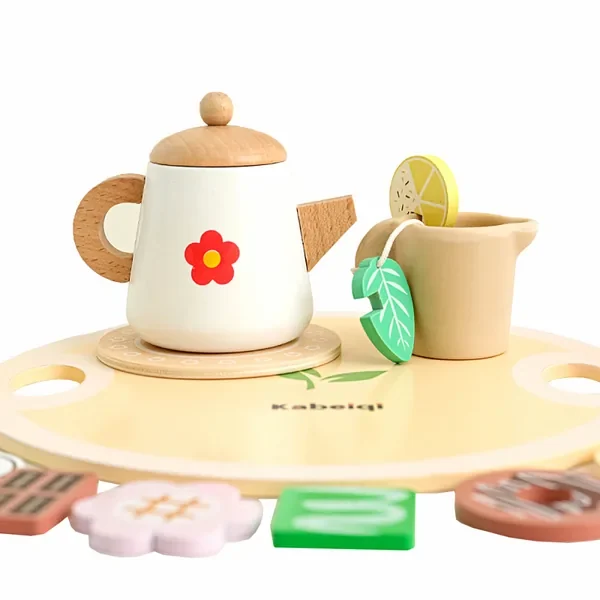
CPS309533 offers a contrasting pretend-play format: a wooden tea set in a 23 × 23 × 7 cm color box. The useful comparison is between its accessible piece edges and the stacking toy’s rims, not between their packaging photographs. Both dimensions describe retail boxes, not cup or tea-piece sizes.
With permission to handle a sample, move a thumb lightly along and across an accessible face, then around its rim. Record where the feel changes: smooth throughout, rougher at an edge, or dragging at a particular patch. Turn the piece under the booth light and describe the sheen as matte, satin, glossy or visibly uneven.
Keep those two observations distinct. “Glossy face, rough-feeling rim” is useful; “water-based finish” cannot be read from shine. Ask to compare another available piece, keeping the same light and handling action so the difference you record belongs to the samples rather than your method.
CPS309533's close-up shows a knobbed lid, pot handle, cup and tray cut-outs. Those are specific handling locations, beyond a general wood texture. Its supply record lists 20 sets per carton, carton dimensions of 48 × 38 × 48 cm, 10 kg gross and 9 kg net; MOQ is 40 sets. A 23 × 23 × 7 cm sales box describes packed presentation, not the thickness or finish of the tray.

How do the peg board and threading beads reveal different working edges?
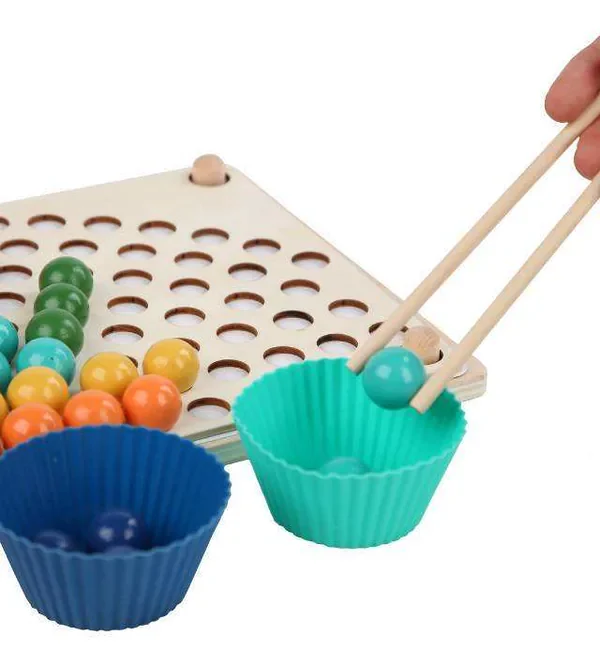
The board compares seating and removing rounded beads; the threading set compares passage through a component. CPS235638 is titled a wooden board-bead game with color-sorting and memory-matching descriptions. Its photo shows rounded beads, recessed positions, a grasping implement and ribbed bowls. Those shapes do not establish a cylindrical peg-and-hole tolerance. Its 31.5 × 19 × 5.5 cm color box is a sales-package measurement.
Place the demonstrated board flat and move an intended bead to its matching position. Observe whether the bead seats and can be removed, then compare another position without forcing anything. For CPS235638, the catalogue groups 24 supply units in a 47 × 33 × 58 cm outer carton, with 18 kg gross and 17.5 kg net; these quantities do not count the loose beads.
CPS303997 is a threading-bead set in a storage box, listed with plastic and wooden materials and a 5–7-year age range. Its title names dinosaur, traffic, animal, fruit and number themes, making it an older-child assortment reference rather than an automatic addition to the baby shelf.
For this demonstration, inspect the hole entrance and exit before passing the supplied threading element through in the intended way. Watch for catching at either end. Keep the note tied to the actual component: a smooth outer face and a hesitant threading action are different findings, and both belong on the fair comparison sheet.
The CPS303997 transport record gives a carton of 44 × 42 × 39 cm, with 15.5 kg gross and 15 kg net. It has conflicting counts of 16 and 18 supply units per carton, so no definite count or MOQ conversion is used here. The storage-box format is still relevant: compare the actual box closure and the separated threading components, without turning carton dimensions into a play-box specification.
How do stacking and memory formats change the handling task?
Stacking emphasizes the contact between parts, while memory play adds repeated placement and removal. CPS280260 is described as a wooden rainbow stacking game, packed in a 21 × 14.5 × 4.5 cm color box. Take its actual supplied shapes as the basis of the demonstration; the title alone does not establish the dimensions of an assembled rainbow or a particular number of rings.
For CPS280260, the catalogue lists 60 supply units per carton, an outer carton of 45.5 × 44 × 47 cm and volume 0.094 m³. Gross weight is 16 kg and net weight 15.5 kg for transport. These figures support keeping sales and transport records separate while the surface comparison remains tied to the handled piece.
CPS307617 is the wooden multiplayer memory-chess candidate. Its product field is 16 × 16 × 4.5 cm, while its listed box is 16.5 × 16.5 × 4 cm. That thickness conflict is left unresolved; neither measurement is used as an exact packaged fit. Instead, follow the intended placement-and-removal sequence on the displayed board, identifying the supporting contacts and any lifting during normal use.
CPS307617 records 72 sets per outer carton, MOQ 72 sets and transport dimensions 51 × 34 × 51.5 cm. Gross weight is 21 kg and net weight 20 kg. Compare the assembled samples on a level table away from its edge, distinguishing stationary rocking from movement that belongs to the game. None of these carton figures supplies a measured tipping threshold.
What belongs on the printable five-point audit sheet?
Use the same five fields for each candidate, marking a field “not applicable” when the play format has no relevant feature. Identify the exhibitor, SKU, sample color or version, and observation date above the table. Record an observation before assigning a preference.
| check | fair-floor action | record |
|---|---|---|
| Grain and surface feel | Lightly compare accessible faces along and across the visible grain. | Location of any roughness or change in feel; comparison with another available piece. |
| Edge radius | Look closely at accessible rims and corners, then trace them lightly where appropriate. | Rounded, abrupt or inconsistent-feeling transition; exact location. Do not invent a radius measurement. |
| Coating sheen and feel | Turn the sample under the same light; record sheen separately from tactile drag. | Appearance and feel by location, without guessing coating chemistry. |
| Bead seating or threading action | Use the intended matching components without forcing them. | Seating, removal, catching or board lifting; identify the actual components involved. |
| Base stability | Observe the assembled sample at rest and during normal demonstration on a level table. | Supporting contacts, static rocking and movement during operation, kept separate. |
How do you turn the observations into a buying reason?
Choose the candidate whose observed behavior best supports the intended play, and state the reason in terms another buyer could reproduce. Prefer “consistent removal across the pieces handled, without holding the board down” to an unsupported claim that one wooden toy is safer or more durable.
Leave a line beneath the audit for: “SKU-specific substrate and finish/coating declaration requested; sample identifier: ____.” The written request should name the wood or composite substrate, coating system and edge treatment, tied to the sample discussed. Keep that information alongside the tactile record rather than treating sheen as a substitute for a finish specification.
For a commercial follow-up, the recorded tea-set range is USD 4.15–4.69 for CPS309533, versus USD 4.80–5.45 for the CPS235638 board. CPS280260 is recorded at USD 2.26–2.50 and CPS307617 at USD 1.50–1.69; these are catalogue bands for different configurations, rather than fair quotations or a ranking of finish quality.
How can you arrange a useful follow-up meeting?
Use the fair’s matching tools to connect a specific sample observation with the right exhibitor. Click2Match is scheduled for January 4–21, 2027, giving the physical visit an online matching window on either side.
The period is December 11, 2026–February 10, 2027, allowing a photographed sample and its finish declaration to remain in the same follow-up record after the physical visit.
On the show floor, can scan booth or product QR codes, open product details, save favorites and provide meeting scheduling, chat and enquiries. Keep the exhibitor reference beside your audit; a QR scan is not itself an appointment confirmation.
Make the meeting agenda concrete: identify the sample, describe the handling observation, and discuss the matching substrate and coating information. That gives the conversation a useful starting point beyond the catalogue image.
Start with the official buyer-registration route
Your next action is to open the and follow its To Visit buyer-registration entry. published process covers personal or SSO information, company details, business-matching categories and purpose, followed by confirmation and an email after successful registration.
If the entry displays “Information will be coming soon,” registration is not yet ready. The explains the process; it does not establish a current fee or deadline.